The Thalorian Tide is a realm of sea power, shipyards, cartographers, and water mages —
a people shaped by harbours, currents, and the belief that survival belongs to those who learn to move with the world rather than against it.
Overview
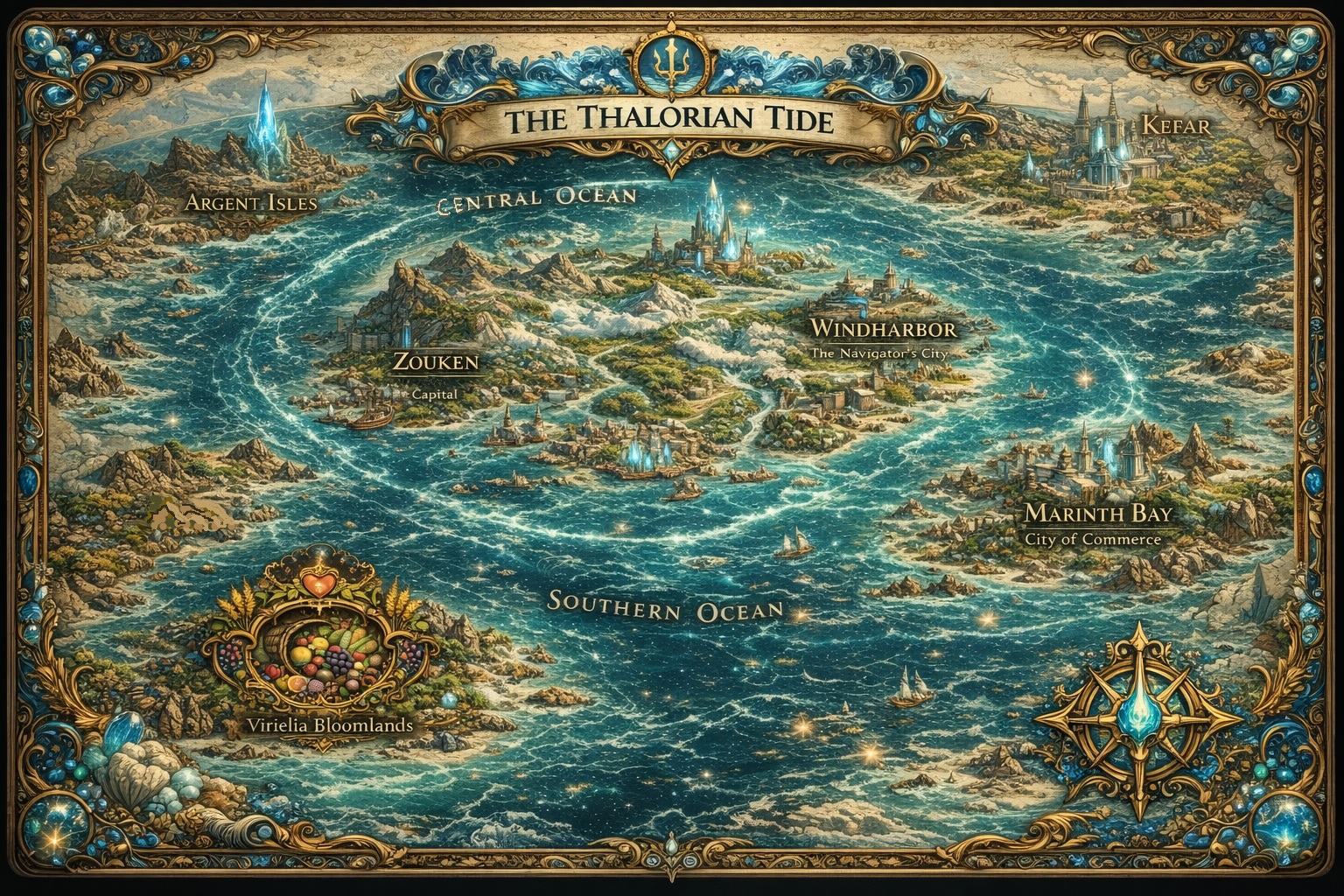
The Thalorian Tide occupies one of the great central continents of Aethoria, surrounded by the waters of the
Central Ocean to the north and the Southern Ocean to the south.
Positioned near the Argent Islands and the great cultural crossroads of Kefar, the Thalorian Tide has long been one of the most influential Crestrealms in matters of trade, science, and maritime exploration.
Few realms have shaped the history of Aethoria’s oceans more than Thaloria.
Among the earliest peoples to master the use of wind-driven sails and long-distance navigation, the Thalorians built a culture whose identity is inseparable from the sea.
From their bustling ports and vast shipyards, Thalorian fleets travel to every coast of Aethoria.
Their vessels carry goods, knowledge, migrants, and ideas between the continents, making the Thalorian Tide both a maritime power and one of the central arteries of Aethorian civilization.
To the Thalorians themselves, this position is no accident. Many among them quietly believe that their realm is the true center of Aethoria, standing above the chaotic politics and shifting alliances of the Mosaic Archipelago.
Geography of the Thalorian Tide
The continent of Thaloria is defined by a dramatic contrast between its elevated interior and its wide coastal regions.
At its heart lies a vast central plateau, crossed by rivers and crowned by several major peaks. These highlands gather moisture from the surrounding seas and feed the many waters that flow outward toward the coast.
The plateau gives way quickly to broad lowlands around the edge of the continent. These coastal lands are broken by bays, inlets, estuaries, and sheltered natural harbours, making Thaloria one of the greatest maritime landscapes in all of Aethoria.
The Central Highlands
At the heart of the continent lies a vast highland plateau, from which several major mountain peaks rise above the surrounding landscape.
These heights collect moisture from the surrounding seas and serve as the source of many rivers that flow outward toward the coast.
These rivers carve fertile valleys across the land before reaching the lowlands near the sea.
Because of this natural drainage system, the Thalorian interior is rich in freshwater and supports thriving settlements, agricultural lands, and centres of learning.
The Coastal Lowlands
The plateau descends relatively quickly toward the ocean, forming wide coastal plains that ring much of the continent.
These lowlands are heavily indented with bays, estuaries, and sheltered inlets, creating natural harbors that have made Thaloria one of the greatest maritime regions in Aethoria.
Nearly every major bay contains ports, shipyards, fishing settlements, or trading towns.
The Thalorians have carefully developed these coasts over centuries, turning them into a network of naval infrastructure unmatched anywhere else in the world.
The Thalorian Sea
North of the continent lies the Thalorian Sea, which connects the Thalorian Tide to the Mosaic Archipelago and the surrounding islands of Argent and Kefar.
This sea has historically served as the gateway through which the Thalorians first expanded their maritime influence.
It is both road and battleground, market and teacher — a sea through which Thaloria learned that to master distance is to master opportunity.
The Capital: Zouken
The capital city of the Thalorian Tide is Zouken, a great coastal city and centre of maritime learning.
Zouken stands as one of the most important academic and naval cities in Aethoria.
Its harbours are filled with vessels from every corner of the world, while its academies train generations of navigators, cartographers, and water mages.
Among its most famous institutions is the Zouken Monastery, a coastal sanctuary for the study of water magic and arcane arts.
Perched on high cliffs overlooking the ocean near the bustling port city of Crystal Quay in Argent, the monastery maintains a deep cultural connection between Argent and the Thalorian Tide and keeps the influence of Thalorian culture ever in the minds of the people of the Argents.
The monastery serves both as a training ground for mages and as a refuge for orphans and displaced children of the sea — and, conveniently enough, reminds the world that the Thalorian Tide is always there to help, especially when people are watching.
Maritime Power and Trade
More than any other Crestrealm, the Thalorian Tide understands that controlling the sea does not require producing everything.
It requires moving everything.
Through vast shipping networks and powerful merchant conglomerates, Thalorian vessels carry goods between nearly every major port of Aethoria.
In doing so, they collect tariffs, commissions, and logistical fees that quietly enrich the realm.
A common saying among Thalorian merchants reflects this philosophy:
“We need not own the cargo — only the route it travels.”
Because of this strategy, the Thalorian Tide has become one of the most economically influential societies in the world.
Navigation and Crystal Technology
Navigation is considered both a science and an art within Thalorian society.
The realm maintains numerous academies dedicated to cartography, navigation, oceanography, and the study of wind patterns and currents.
Thalorian ships often employ crystal-based magnetic instruments that allow navigators to determine direction even during storms or heavy fog.
These crystals interact with the natural magnetic energies of Aethoria, forming one of the earliest known navigation systems in the world.
In their homeland, similar crystal technologies are used to regulate wind power and support maritime industries.
Culture of the Sea
Fishing and seafaring form the backbone of daily life throughout the Thalorian Tide.
Communities along the coasts depend heavily on the ocean for food and trade, and generations of sailors pass down knowledge of tides, storms, and currents.
Despite their pragmatic and commercial mindset, Thalorians maintain a deep respect for the sea.
The ocean is viewed as both provider and destroyer — a force that cannot be fully controlled, only understood.
Orphanages and the Children of the Sea
Because maritime travel carries constant risks, the Thalorian Tide sponsors a wide network of orphanages and social institutions throughout Aethoria.
These organizations support children and families who have lost loved ones to shipwrecks or maritime disasters.
Many such children are later trained in navigation, shipbuilding, or magical disciplines connected to water.
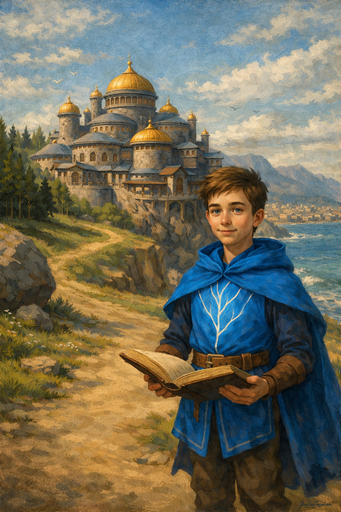
One such child was Zelnard, a water mage trainee originally born in Thaloria who later studied at Zouken Monastery after losing his parents in a shipwreck near Crystal Quay.
Reputation Among the Crestrealms
The Thalorian Tide presents itself as a practical and stabilizing force in Aethoria.
Through trade, navigation, and maritime services, it connects distant lands and cultures.
However, Thalorians often regard themselves as culturally superior to the fragmented political systems of the Argent Isles, whose mixture of peoples and constantly shifting policies they view as chaotic and inefficient.
To many Thalorians, their realm represents the disciplined order that keeps the wider world functioning.
Whether this belief reflects reality or pride remains a matter of debate across Aethoria.
Creatures of the Thalorian Seas
The waters surrounding Thaloria are home to numerous marine species.
Among the most notable are the Fesealon, often called aquacats, lava-spring mammals that inhabit the rivers and seas around Argent and Thalorian islands.
Their crystal-infused skin and powerful swimming ability make them well adapted to the turbulent waters of the region.
Another creature associated with colder waters near Thaloria is the Luffy Waterbird, a hardy seabird capable of surviving extreme climates in the subpolar regions of Aethoria.
Major Coastal Cities
Zouken — Capital of the Thalorian Tide
Zouken stands on the western coast of the Thalorian continent, where the waters of the Thalorian Sea open toward the Mosaic Archipelago.
Built upon sweeping stone terraces above the ocean, the city commands one of the most strategic harbours in all of Aethoria.
Port Thalara — The Great Shipyards
Port Thalara lies along a wide sheltered bay on the southeastern coast of the continent.
Its natural harbour forms one of the safest anchorages in the Central Ocean, allowing hundreds of ships to dock at once.
Marinth Bay — City of Commerce
Situated on the northeastern coast facing the Mosaic Archipelago, Marinth Bay serves as one of the primary trade gateways between Thaloria and the islands of Argent and Kefar.
Windharbor — The Navigator’s City
Windharbor rests on the northern coast where strong ocean winds sweep constantly across the headlands.
Its tall observation towers and wind instruments make it one of the most important meteorological centres in Aethoria.
The Great Coastal Cities of the Tide
Zouken is the intellectual and strategic heart of the realm, where navigators, mage scholars, and merchant houses meet to plan expeditions and regulate the shipping routes that sustain the Thalorian economy.
Port Thalara is famed throughout Aethoria for its massive shipyards, where fleets of merchant vessels and exploration ships are constructed.
Entire districts of the city are dedicated to shipbuilding, and the sound of hammers, saws, and wind-driven cranes fills the air day and night.
Marinth Bay is crowded with merchant ships from every corner of Aethoria.
Markets line the waterfront, where goods from distant lands are unloaded and redistributed through Thalorian shipping networks.
The city is also home to several powerful shipping conglomerates and merchant guilds.
Windharbor is one of the great centres of navigation science.
Here, scholars and sailors study the movement of ocean currents, storm systems, and seasonal winds.
These observations are recorded and shared with Thalorian fleets, allowing their ships to travel with remarkable efficiency across the oceans.