Quest 1: The Empty Vein
The Empty Vein
By the third morning after the uprising, Kefar still had an air of pretence that tried to disguise the fear that gripped the city. The High Council would have them believe nothing had happened. The people of Kefar could see and still feel that that was a fallacy. No announcements were being made. No reports on injuries or losses posted. The blood had been washed from the pale stones of the Exchange Amphitheatre. Torn banners had been taken down before anyone could decide whether they were evidence, symbols or simply ruined advertising. Masons knelt along the avenues replacing paving stones cracked by Guardian shields, while apprentices from the Navigation Hall collected spent crystals from the gutters with padded tongs.
The crystals were no longer blue. They lay in baskets like pieces of clouded glass, grey at their centres and webbed with tiny fractures. Councillor Thrankal stopped to inspect the work as his litter passed an exhausted boy dropping another into the basket.
“Careful with that,” he said.
The apprentice looked at the dead stone and then at Thrankal. “It is spent, Councillor.”
“It remains Council property.”
“Yes, Councillor.”
The boy lowered it with exaggerated care. “Gulather’s ass!” he uttered under his breath. Thrankal suspected insolence but could not prove it, which had become a common feature of his government in Kefar, particularly evident after the riots.
Blame was placed squarely on religious extremists who had gone so far as to ransack unprotected sections of the library in search of fictitious documents they claimed were holy. They had burnt and destroyed precious papers and artwork dating back hundreds of years. The entire Library of the Crysalise had been shut to the public since that day, in stark contrast to the government’s claim that all was well again.
Inside the Council chambers, the long table was crowded with ledgers, requisition slips and people determined not to accept responsibility for any of them. Two chairs remained broken from the night of the riot. No one had ordered replacements because doing so would require identifying the office responsible for the damage.
“How many charged reserves remain?” Thrankal asked when he arrived from surveying the city’s recovery efforts.
The keeper of the city stores adjusted her spectacles. “Enough for twelve days of ordinary use.”
“And if there is further disorder?”
She examined another column. “Perhaps four.”
Someone at the far end of the table stopped breathing loudly enough to be heard.
“Four days?” Councillor Menard asked.
“Possibly five, if the healers agree to reduce emergency allocations.”
“The healers will not agree,” said Thrankal.
“Then four.”
“And there are rumours of unrest still brewing in the Fire Quarter. Some there are convinced the riots—”
Thrankal interrupted with a little throat-clearing. “Ahem. The local incidents.”
“Sorry. Some are convinced ‘the local incidents’ were part of a councillor plan to evict the poorer tenants of the Glass District so that we could rebuild it with council-contracted work.”
“Ridiculous,” Thrankal said. “We have our hands full with the city wall reconstruction.”
Menard leant closer to Thrankal and said almost inaudibly through a smile, “Some hands are fuller than others.”
Thrankal returned the smile with a raised eyebrow, then pushed away the nearest ledger. He had almost had enough of it all. Every page told the same story in a different arrangement of numbers. Guardian barriers had consumed crystals. Healers had emptied them. Fire suppression, Voice Casting, signalling and the defence of the Heartwell approaches had required still more. The rebellion had been crushed, although the word *crushed* appeared nowhere in the official account. According to that account, public order had been restored through measured intervention.
Measured intervention had used thirty-seven per cent of Kefar’s stored charge.
“Recharge them,” Menard said.
The keeper removed her spectacles. “We are recharging them.”
“Then I do not understand the difficulty.”
“A crystal is not a bucket, Councillor. Each charging weakens its internal structure. Some can be filled twenty times. Some ten. Some fail after three. Nearly half the crystals used during the uprising had already passed their recommended life.”
She lifted one of the grey stones from a tray. Under the morning light, pale fractures shone within it like lightning trapped in dirty ice.
“We can place this in a cradle,” she continued. “The Heartwell can pour energy into it. The stone will not hold that energy. It may crack, melt or release the charge into the person standing nearest.”
Menard leaned away from it.
“Then replace it.”
“With what?”
Silence settled around the table.
Thrankal stood. “All crystal problems begin in a mine. Everything after that is accounting.”
The keeper looked as though she might object, but he had already fastened his cloak.
“I will go to Ironroot Bastion and inspect the northern workings myself.”
“You are leaving?” Menard asked.
“I am acting as a good and wise leader must in times of crisis.”
“The city is still unsettled. There may still be a crisis here.”
“The council is made of eleven, so I am sure the other ten can manage a little street scuffle should one arise.”
Thrankal fixed him with a patient expression. “Should you see a scuffle, do send word to me in Ironroot and I will say some prayers on your behalf in the Veylborn Shrine of Karvok while you settle it.”
Karvok did not look like a capital to Thrankal, but he was glad to see it after a week-long voyage. Northern winds sometimes fell silent in late summer once ships had left the wild Central Ocean and entered the shallow, marshy lowlands near Bordrad. The largest docks were safe in the calm waters around the southern Ironroot archipelago, though the channel had to be dredged every few years for the large Thalorian cargo ships to berth. From there, it was several days to the city, so his relief was real but short lived.
There were no broad marble roads, no disciplined rows of stone houses and no single palace rising above the town to remind citizens where decisions were made. In fact, arriving in a swamp was a metaphor for how one should see Karvok, Thrankal often told his fellow councillors. The city climbed into the forest. Immense living towers rose from trunks and woven branches, their floors hidden behind leaves, flowers and suspended walkways. Children ran across bridges high enough to make a Kefarian engineer refuse the assignment. Birds nested in government roofs. Even the great Ironroot Bank’s first branch had been built in the hollow of a tree.
“How these people became the bankers of the world I’ll never know,” Thrankal said to his adjunct as he disembarked from a “very shoddy carriage.”
Chief Panarf met Thrankal beneath the open canopy of the Great Hall. He wore no crown. A broad iron clasp fastened his green cloak, and the scar across his left forearm was more impressive than any ornament. He was an impressive figure, with broad shoulders that exuded power, contrasted by a contented smile that was his default expression.
When Thrankal alighted backwards from the carriage, his first step landed on the footboard and the second directly in a small, fresh pile of gulather patty.
Panarf harrumphed and said, “Mind your step in Ironroot, Councillor,” gripping Thrankal’s forearm to extricate him from the shitty situation.
The grip was unnecessarily firm but entirely unconsciously so, and Thrankal was glad for the help. He took out a clean cloth, attempted to wipe the excrement from his boot and then dropped the cloth on the ground.
“Chief Panarf. It is a great honour to be in this magnificent city again.”
Panarf relieved him of his embarrassment by ignoring the gaffe. “You travelled quickly.”
“Well, to be honest, my…” Thrankal, who barely came up to Panarf’s shoulders, punched him in the bicep. “…strong friend, Kefar’s need is urgent.”
“Ironroot’s needs have been urgent for three hundred years. We learned to make tea.”
Thrankal could not tell whether this was humour or if something had been lost in Panarf’s use of the Common Tongue. Panarf signalled to an attendant, who offered him a steaming cup of tea in an exceptionally crafted vessel made of finely beaten gold.
The tea tasted of bark and smoke and contained the residue of a starchy plant that thickened it into small clumps.
“Excellent,” Thrankal said, sipping ever so slightly and eyeing the cup while avoiding a diplomatic incident by not grimacing.
“No one likes it on the first cup,” Panarf replied.
“I seem to remember having some last time. Such pretty beverage containers.”
“Come. We’ll eat and talk and tomorrow we go north.”
Thrankal was relieved not to be in a carriage or doing any kind of travelling, but was a little concerned about the “we’ll eat” part.
The next day’s journey carried them beyond Karvok’s living towers, through grasslands bright with late flowers and into the first hard slopes of the Saviours. The mountains stood like a white wall across northern Ironroot. Beyond them lay the Dereliction Lands, unseen by Thrankal, though he knew no one who had not heard of them. Watchtowers occupied every ridge, and the Guardians travelling with Panarf looked north more often than they looked at the road.
They did not fear invasion. As a collection of city-states run as chiefdoms, the entire continent was safe from Aethorian enemies, but they did fear any beast that came south from the Dereliction Lands. The purple-and-black viscous material that oozed from plant life there was still slowly making its way south, kept in check only by the mountains, which made plant life untenable at higher elevations.
Any creature that consumed the corrupt plant matter was slowly infected until its behaviour and even its appearance were affected. The creatures lost their natural fear of predators and Aethorians, biting or attacking objects and other animals for no reason. They might run long distances making unnatural noises or scream in what local Guardians knew as a devil’s tongue. Infected creatures would spit foam and avoid any form of water. Guardians along the border of the Dereliction Lands often dug trenches and allowed water to fill them as a line of defence. Their fears were well justified and made even Panarf cautious.
The mine entrance had been cut into a dark shoulder of stone below the snow line. Timber braces framed the opening. Carts stood beside it, most of them empty.
A miner emerged with grey dust covering his hair, his beard and every line around his eyes. He held a short iron tool but no crystal.
“This is Mine Captain Edran,” Panarf said.
“Councillor.” Edran nodded.
“Your latest shipment was less than half its contracted quantity.”
Edran was a little insulted by the lack of protocol and the immediate accusation of a lack of effort.
“What, no tea?”
“It was less than half last year’s quantity.”
“Chief Panarf. You honour us with your visit. Would you partake of a cup?”
“Edran, you honour us with your labour and Ironroot grows strong. Your tea will warm my lips and wash dust from my throat tonight.”
Thrankal looked to his adjunct, awaiting translation, as the exchange was entirely in Karvokian.
“Chief Panarf, could you please tell this fine, hardworking miner that this mine is underproducing and we need more?” Then he looked at Edran and said in crudely spoken and overly loud Karvokian, “More!”
Edran looked back into the mine, speaking in perfect Common Tongue. “I have worked that face for days. It has given us nothing. You are welcome to ask it more firmly.”
Panarf coughed into one hand. It did not completely conceal his smile.
They entered beneath lantern light. The mine narrowed as it descended, its walls scored with old cuts and newer tests. Here and there, empty crystal impressions remained in the rock: six-sided hollows, branching pockets and smooth cavities where something had grown for centuries before being removed in an afternoon.
Edran stopped beside a fresh wall.
“The main seam continued here.” He ran one hand along a pale mineral line. “Every record also says so, but it peters out to nothing in that slip. My grandmother followed the same vein forty paces east and brought out enough charging stone to supply Karvok for a season. We have driven twice that distance and found dust.”
Thrankal examined the wall. “Then your records are wrong.”
“The empty carts are right.”
A woman in a fur-lined work coat waited farther down the passage. Dark stains marked the cuffs of her gloves.
Panarf introduced her as Master Tracker Ressa, a Guardian naturalist assigned to the northern boundary.
“A tracker in a mine?” Thrankal asked.
“Something has been leaving tracks,” she said.
She led them through an abandoned branch tunnel. The air changed first. It became cold and carried an acrid odour of burnt resin and wet decay. Purple-grey moss covered one support beam. Beneath it, black liquid gathered in a shallow depression.
Thrankal stopped. “Runoff from the mine?”
“From which mine?” Ressa asked.
“This one.”
“The branch was closed nineteen years ago.”
She crouched without touching the black pool. “We find this farther south every season. It appears on the outer edges of the drives, then the moss changes. Then insects. Then larger animals.”
“You are suggesting mining creates the Dereliction?”
“No, I am saying the corruption advances faster through places from which large crystal growth has been removed.”
“Is that not the same thing?”
“No,” Ressa said. “It is the thing we can prove.”
Edran pointed to the wall above the stain. “We left three crystals in this branch because they were badly formed. The black growth stops around them.”
“Coincidence.”
“Perhaps,” Panarf said. “But when a coincidence repeats for generations, an Ironroot eventually gives it the dignity of a warning.”
Thrankal turned towards him. “Kefar requires replacement crystals. Your own healers and Guardians require them. If production stops, Ironroot will suffer with everyone else.”
“We know.”
“Then expand the northern works.”
Edran laughed once, without amusement. “Into the Dereliction?”
“Not beyond the Saviours. Along the protected slopes. Kefar can provide labour.”
Ressa stood. “Whose labour?”
“Workers from Crestrealms where employment is scarce. They would receive wages, housing and the protection of your Guardians.”
“You want poor foreigners to dig where our miners refuse,” Panarf said.
“I want people who need employment to perform necessary work.”
“Those sentences often wear the same cloak.”
Thrankal’s patience thinned. “Kefar can increase payment for every viable crystal. Improve the camps. Supply food. Your people would profit.”
Panarf looked at the empty crystal hollows in the wall.
“You speak as though the land has refused a price because the offer was too low.”
“Everything has a price.”
“That is a Kefarian belief.”
“It is a mere economic fact.”
“You can buy a bigger bucket, but it won’t pull water from a dry well.”
Thrankal didn’t wait for a translation of that adage. He understood it well enough but chose to ignore it, as all of the highest-quality power crystals came from the very place where he was standing.
He glanced back towards Edran and Ressa, then lowered his voice. “If this vein is finished, open another. If no safe vein remains, drive the old workings farther and recover what they still contain.”
“And if the mountain contains no more than you have seen?” Panarf asked.
“Then use the gold beneath your trees. The Bank of Ironroot holds reserves large enough to purchase every lesser crystal the Verdant Expanse can spare, and enough besides to draw shipments from neighbouring Crestrealms. Poorer stones will fail sooner, but quantity may compensate for quality until a new supply is found.”
Panarf’s contented expression had disappeared. “You came to inspect a mine. Now you propose spending Ironroot’s reserves for Kefar.”
“For Aethoria,” Thrankal corrected. “And I came because our difficulties are no longer limited to empty mines.”
He allowed the silence to gather before continuing. “The warrant concerning Anderix names those who assisted his defection and those implicated in the offences committed in Thaloria. Kaelen Thorne is known to me. So are his companions.”
Panarf did not move.
“Blena has not been overlooked,” Thrankal said.
The mine seemed quieter than it had a moment before. Even the distant blows of iron against stone had stopped, though Panarf knew they had not.
“If you have come to threaten my daughter,” he said, “you should have brought more Guardians.”
“I am offering context. When warrants are reviewed, the Council must distinguish wilful enemies from young people drawn into another’s crime. Cooperation from Ironroot would make that distinction considerably easier to defend.”
“Will you remove her name?”
Thrankal gave him the regretful look of a man prevented by law from granting a favour he had never clearly offered. “I will ensure that every relevant circumstance is heard.”
Panarf studied him for a long moment. “Then you have promised nothing.”
“I have promised attention,” Thrankal said. “In Kefar, that is rarely nothing.”
On the walk back, Thrankal allowed Panarf and the trackers to move ahead. Mine Captain Edran remained behind to secure the gate.
“Captain,” Thrankal said quietly, “expanded operations would require a regional director.”
Edran continued fastening the chain.
“A person familiar with both the workings and Kefarian expectations. The appointment would include a percentage of every new contract.”
The chain stopped moving.
“You are offering me control of the entire southern slopes?”
“I am offering responsibility to someone who understands production and who believes, like me, that if we push a little harder and dig a little deeper, perhaps take some ‘derelict’ risks, we will find what we need.”
Edran pulled the chain tight. “Chief Panarf understands distribution.”
“He understands trees.”
The captain turned. Dust had settled in the creases of his face, but his eyes were very clear.
“A tree knows when to stop growing. That makes it cleverer than most councillors.”
He walked away before Thrankal could answer.
Fateese had discovered that some hats were not a disguise and were, in fact, like shaking meat at a scaleback runner. Even people who had never noticed him before were looking as he passed in an oversized hat with a brim that fell down to cover his forehead and cast a shadow on his face.
Since the riots, he had found it necessary to remain at home if he wanted to stay in Kefar. When he ventured out to the store, his pantry surviving on weekly replacements only, he was very mindful of being recognised. Once, a Syterran priest had been at the Northwall Market and looked at him twice. With his woollen hat pulled down so low that he had to tilt his head back to see where he was going, Fateese had lost him somewhere along the western sea wall before heading back to his house in the night, still hungry.
This time, the wide brim had covered his face, but his rotund shape and ungainly wobble were spotted by the server at the street kitchen he frequented when in a hurry.
“I told myself, that looks like F,” said the woman across from him.
He removed the silly hat that had failed to conceal his identity. Parts of its front edge had dipped into his fish broth, so he laid it beside his bowl to dry.
“Morning, Grucy,” Fateese said meekly. He was glad that the one who had broken his secret dress code was actually someone who should know him anyway.
“You should try dressing less like a woman. A lot less likely to be noticed.”
“This is a distinctly masculine hat, I’ll have you know. I paid three gold pieces for it from a Sylvan trader.”
“Makes sense! Have you seen the Sylvan men? All silk and flowy, in purples and pinks, and walking and standing straight-backed. How their Guardians fight in that garb I’ll never know.”
“I’ll go back to my cap next time, but I’m fairly safe up here in the north. The low rents, the hole in the wall and the bad food keep Kefar’s upstanding citizens far away, and that’s fine by me.”
“Food’s not that bad here. Maybe a little old, but with some salt…”
“It should be required to disclose each item’s date of birth on the menu.”
The woman pushed a sealed blue envelope across the table. Fateese covered it with his broad hat, which made the transaction considerably more suspicious.
“From her?” he asked.
“Read it somewhere private.”
“I am wearing another man’s hat and clothes in a back-alley kitchen. How much more private can a person become?”
The door opened. Fateese snatched up the hat and pressed it to his head upside down. It dripped.
The newcomer stared at him.
Fateese corrected his hat and lowered the brim. “Good afternoon,” he said, trying to cover the gaffe with mundane cordiality. It just made it worse.
“Fateese?”
“No.”
“It is you.”
“Good Veyl, man! Can’t a random customer enjoy their meal without harassment?”
“Your hat is… dripping on your nose.”
Fateese adjusted it. “A regional fashion.”
“Who are you?”
“It’s me, Stenor. You sent a request to the Keeper of the Heartwell to charge the new Sylvan crystal ahead of the order?”
“Yes, yes. Quietly, man! Walk with me.”
He gathered the letter and hat, abandoned his soup and hurried into the alley. As he left, he heard another customer ask Grucy, “Does he come here often?”
“Well, that’s another source of food off the list!” he said to Stenor, a reminder that he would have to avoid Dorn’s Street Kitchen from now on.
“The Keeper of the Heartwell was difficult to get to. I had to arrange a few extras for him to skip over the Verdant Expanse recharge. He will be moving into a new villa by the southern sea wall next week.”
“A villa! Are you out of your mind?”
“Your message said spare no expense, and none was spared, let me assure you. This place has a balcony that provides access to the water and a saltwater pool that is geothermally heated.”
Fateese was dumbfounded. “Have you seen where I am presently finding refuge? Do you see this alley and these streets?”
As if on cue, a sewer rodent darted into a gutter up ahead, surprised by Fateese’s lament.
“Well, the thing is, the villa was a little more than I had, and I knew how much you needed the crystal, so I agreed pre-emptively, and now…”
“But the crystal was charged already?”
“Yes.”
“And shipped already?”
“Yes.”
Fateese saw his opportunity. “And so you are out of funds? Well, guess what? So am I. You will have to find someone else to cover your expenses.”
“What?”
“Do you think me stupid? I know the cost of a villa and also know how much gold I gave you. It seems you had a few parties at your own home too.”
“I had to entertain to build connections. It was all part of the—”
“Enough. I don’t have time for this.”
“But I went to moneylenders for the shortfall!”
“Then I suggest you leave town before they notice the lack of repayments.”
“Wait, there is more. I think there is something wrong with the Heartwell.”
Fateese stopped.
“Explain yourself. What is ‘wrong’ with the Heartwell?”
“I don’t know, but I can find out.”
“Well, I suggest you do, and before your underworld friends decide they would like the next installment.”
Fateese had led them back to his home, where one of his men sat on a stool in an alley next to the side door.
“Well, here we are at my ‘Not a Villa’ home.” He looked at Stenor. “Find out what you can.” Then he looked at Drell and signalled that Stenor should leave before going inside.
Delrona’s message contained no gracious platitudes or praise for his hard work. It was cold and lacked any sort of greeting.
Now is the time to swoop in. Set a meeting with the councillors who fear Thrankal more than they fear change. Tell them you know someone who can quiet the Syterran factions and may possess a solution to the crystal shortage. Do not promise the solutions or expand on any details. Let them imagine all kinds of possibilities.
Fateese read it twice before thinking, *Expand on details? Highly unlikely, seeing as I don’t have any and you didn’t supply them.*
He still couldn’t believe how well the uprising had worked. Delrona had supplied suggestions, rumours, money and one very gifted speaker, though he had no idea at the time. Kefar had supplied the tinder, history and time the fuel, and he the spark. By the end, citizens who agreed on almost nothing had united in their certainty that the Council was not trustworthy and was hiding the “truth” about Syterra and the unification of all powers in one human actuator.
Fateese folded the letter.
“I did not even have to leave,” he murmured. “Marvellous city, though I will have to find some new restaurants.”
Far to the southwest, drizzle welcomed the honoured guest. A canopy was hastily erected over the gangplank where she would disembark. Students from the Girls’ School of Sylvan Supremacy lined her path with flowers and ripened grain stalks from the Virielia Bloomlands as symbols of wealth. Delrona walked off the ship into a constructed display of welcome that caused every onlooker to take note. A carriage awaited to whisk her away to the capital. She walked past the girls, accepting flowers and gifts, smiling and waving at the crowd that had begun to gather.
“Who is that?” a dockworker asked his fellow worker, who had stopped to watch from afar.
“No idea, but she must be important with all that fanfare. That’s a government carriage right there.”
Once in the carriage, Delrona scolded the school principal, who was waiting patiently. “I thought I asked for music, and what was that? You call that a crowd? I’ve seen more people at my afternoon tea.”
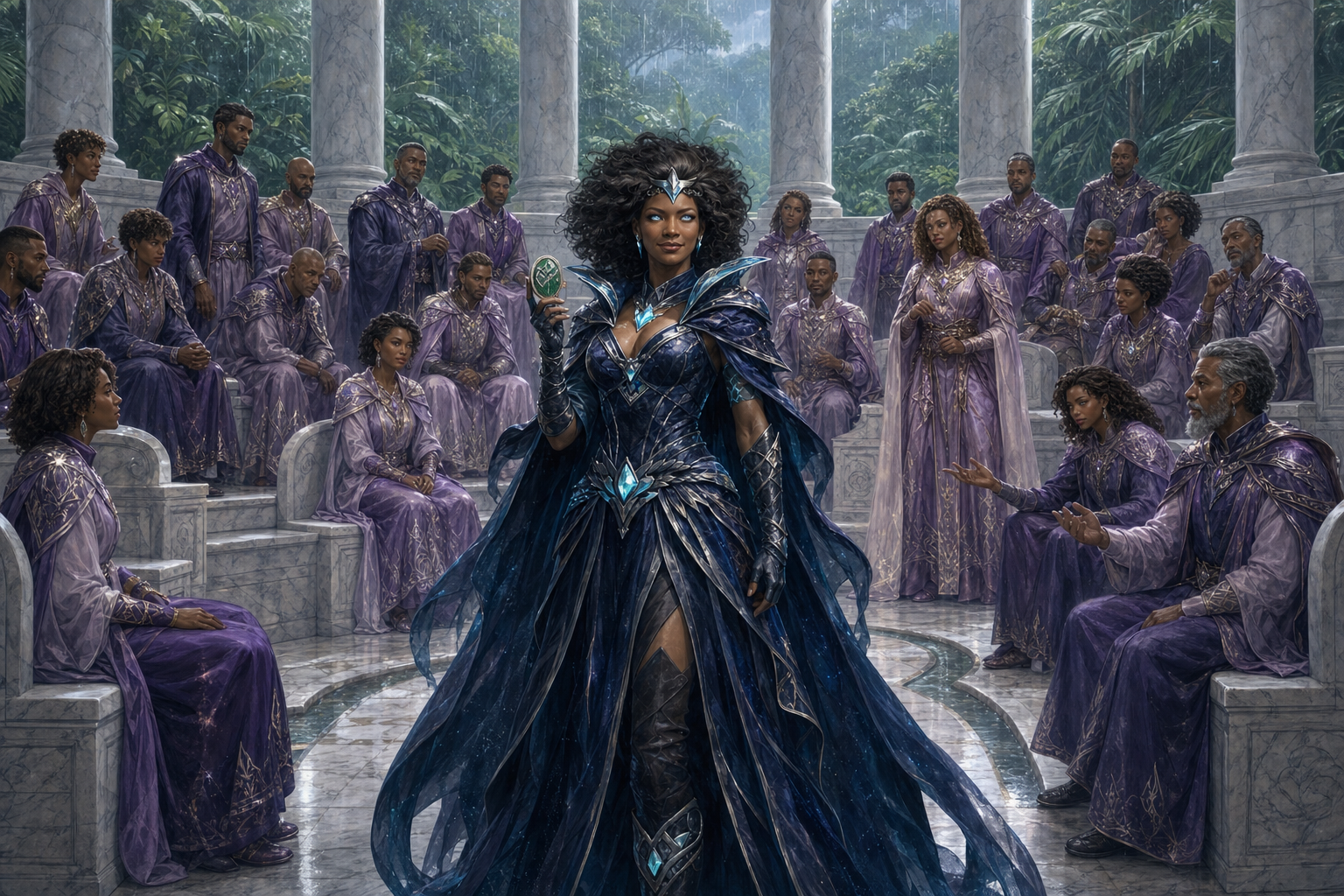
Delrona stood before the Sylvan Watch senators in a chamber whose open walls looked into the deep forest. Water travelled down chains from the roof into marble channels, filling the room with a soft and constant music.
On the ground outside in the courtyard lay the massive, exhausted primary crystal.
It was the Crestrealm’s main power source, and it was longer than the carriage in which Delrona had arrived, including the horses, but it was almost colourless.
“Four days,” said Senator Avara. “The previous crystal sustained the regional cradles four days longer.”
“And Kefar’s annual replacement?” Delrona asked.
“Delayed.”
“By how long?”
“They will not say.”
“Then they are concealing the answer.”
Another senator shifted uncomfortably. “Or they do not possess one.”
Delrona allowed that possibility to settle. Fear was most useful when people developed it for themselves.
“Well, that is typical of Kefar. Bad news followed by excuses, but I have good news. My quarry in the Verdant Expanse has sourced crystal of the highest quality. Able to hold a charge over more refills than any Kefar can provide. Enough for our primary crystal to power hospitals and local defensive reserves,” she said to all the senators who had gathered. “I anticipated the need for the drained crystal and had already sent one to Kefar for cradling, and a replacement is already on its way. Should be here any day in fact. The Crestrealm need not suffer as the others do under Kefarian control. And with a supply of pure blue power crystals from my mine, it will be enough to prevent more disruptions in the future.”
“Your quarry is already a point of dispute,” Senator Vilna reminded her. “Verdant officials accuse Sylvan companies of importing workers, depressing wages and provoking violence in their southern cities.”
“Verdant officials blame foreigners whenever their own Guardians lose control. My workers receive housing, food and wages. The quarry’s profits support two schools, three healing charities and the winter employment fund here.”
“Your generosity is well advertised.”
“Generosity that no one knows about feeds very few people.”
Avara almost smiled.
Delrona looked outside into the courtyard at the grey, dead crystal. “Kefar has deliberately delayed the power owed to us, refuses to explain why and expects patience because patience costs them nothing. I suggest we send someone who understands crystal extraction, trade and diplomacy.”
“You are proposing yourself,” said the spurious Senator Pluo, who feared Delrona but was fiercely in the Crestrealmist camp.
“I am available. Is that a nomination?”
Senator Unon, who was not a believer in the politics of Sylvan dominance, interrupted. “You are known in Kefar as the one who disrupted a Voice Casting and accused the Heartwell Council of manufacturing false history. Is this who the Sylvan Watch would send?”
“Senator Unon, it was six years ago. I was younger, and Kefar is a different place these days. Its streets are filled with violence and its people crave change. They would welcome a free thinker such as myself, should the Senate empower me, that is.”
Senator Unon finished with, “We risk isolation if we misstep in Kefar,” before sitting down and symbolising the completion of his argument.
The senators exchanged looks. Delrona could see that some agreed, so she continued. “After years under the yoke of Kefar, I understand trepidation. However, with our own crystals, an upcoming supply of power crystals and a representative in Kefar who would bring Sylvan rights to the fore, we will rise to be more than a southern backwater, the supplier of marble and Sylvan skills.”
“If you were to speak only on the delayed crystal,” Avara said.
“Of course, if it is the will of the senate, only those matters.”
Senator Pluo added, “You would possess no authority to negotiate military, territorial or permanent trade agreements.”
“I seek answers, Senator, not an empire.”
That was close enough to the truth to pass comfortably between the factions in the Senate, and Pluo had made enough of a show.
Avara opened a carved box and removed the green-and-silver seal of a Sylvan envoy. She held it for one final moment.
“You will speak for the Sylvan Watch in matters concerning the delayed crystal.”
Delrona accepted the seal with a bow. “For the good of the Sylvan Watch.”
Outside, the rain strengthened. Water ran from the marble roofs, along carefully cut channels and into the forest below. Delrona closed her hand around the seal. She had entered Kefar before as a scholar, a merchant and an unwanted speaker. This time, as an ambassador, Kefar would be required to listen.
Continue to Quest 2
The fugitives climb into the Emberwild Highlands and discover Kael’Voryn, the City of Wings.