Quest 2: Deal with the Devil
Deal with the Devil
Thrankal had been given rooms in one of the finest establishments in Ironroot the Forest Inn. It was interwoven with a tree that was 20 meters across and 100 meters to the top. It stood opposite the Ironroot Bank. Foreign officials could enjoy Karvok without being required to sleep in anything that moved with the wind in its largest guest rooms which had balconies that wound around the inner rooms and led to stairs for the second story of the apartments.
Blena had returned to see her mother who was overjoyed with what she thought was her return. They stayed up late by wax candlelight talking into the morning and she did not mention the argument with her father. After a hearty breakfast of Yellowtail eggs in buns and more tea Blena and Kaelen walked to the Bank together through a misty rain that began as they left. They stopped the instant they entered the covered financial district which had gold exchanges, the Ironroot Bank central branch, clerks and offices and businesses that survived off the lending and repayments of gold and bonds.
“Such a contrast,” Kaelen said.
“That’s Ironroot Bastion for you, green and gold as far as the eye can see, and some crystals thrown in for good measure..”
“Most people seem unaffected by all the wealth. I mean except for all these people around here.”
“Yes, this is the street that will test your true identity more than any right of passage trials in the forests and marshes.”
They found Thrankal eating breakfast inside a quaint breakfast house the served fresh fruit purees and charged handsomely for them. He sat beside a window overlooking Assembly Square. Two adjuncts sorted papers at a smaller table. A large Kefarian Guardian stood beside the door, apparently there to protect the Councillor from the requests from hopeful financial dealers but mostly to keep back the waiters that offered tea.
Thrankal looked up, froze with a spoon of limberry halfway to his mouth, then recovered so quickly Kaelen might have doubted the reaction.
“Kaelen Thorne.”
His gaze moved to Blena.
“And the Chief’s daughter. What an entirely unexpected pleasure.”
“You knew we were coming,” Blena said.
“Karvok knew. I merely benefited from the general enthusiasm.”
Thrankal dismissed the adjuncts and the Guardian. When the door closed, his diplomatic smile became something more genuine.
“You are alive.”
“Disappointed?” Blena asked.
“Relieved. Dead investigators produce terribly incomplete reports.”
Kaelen remained standing. “Are we investigators?”
“Of course.”
“The warrant calls us fugitives, thieves and foreign agitators.”
“Administrative language often lacks subtlety.”
“It accuses Anderix of being abducted.”
“The Mechanum Ascendancy accused you of abducting him.”
“He stayed voluntarily.”
“Mechanum citizens are not encouraged to possess a voluntary relationship with foreign policy.” Blena took the chair opposite Thrankal without invitation. “Withdraw the warrants.” Thrankal returned his spoon to the bowl. “I cannot.” “You sent us.” “The Council authorized an investigation of the Heartwell fluctuations. It did not authorize entry into restricted structures, damage to ancient sites, interference with foreign authorities, unauthorized crystal use or the disappearance of a Mechanum national.” “You knew we would have to travel.” “Travel is not usually classified as disappearance.” Kaelen placed Thrankal’s original authorization on the table. The paper had been folded, soaked, dried and folded again so many times that it had become soft along its creases. “Your seal opened the first doors,” he said. “Then you denied it meant anything whenever those doors led somewhere dangerous.” Thrankal looked at the seal but did not touch it. “Alfer saw Guardians coming for us,” Kaelen continued. “He led them away so we could escape. No one has seen him since.” Something shifted behind Thrankal’s expression. It was slight, but not slight enough. “When?” “Does the date change your responsibility?” Blena asked. “It may help determine what happened.” “We know what happened. You called us fugitives and Guardians began hunting us.” “I issued no order for anyone to harm this “Alfer”. Truth be known, I barely know the names of your investigative team.” Blena leaned across the table. “You wrote the warrant. You gave the Guardians someone to chase. Alfer who is Alster brother, who is ... who was 15 put himself between them and us, and now he may be buried somewhere because of it.” “We do not know that he is dead,” Kaelen said quietly. “No,” Blena replied, without looking away from Thrankal. “We only know he vanished more than three months ago while your Guardians were pursuing him. I am sure that distinction is very comforting to you.” Thrankal’s jaw tightened. “They are not my Guardians.” “That is your defence?” she asked. “It is a fact.” “Then here is another. If Alfer is dead, your warrant killed him. Perhaps not by your hand, and perhaps not by your command, but do not sit there eating crushed fruit and pretend you had no part in it.” Silence settled over the table. Beyond the window, clerks and traders continued crossing Assembly Square beneath their umbrellas, unaware that Blena had just accused the High Councillor of murder over breakfast. Thrankal pushed the bowl away. “Where is the healer, Alster? He’s Virielian no?” Thrankal was attempting to sound empathetic but showing he knew others in Kaelen’s party. “Searching for his brother,” Kaelen said. “Because he refuses to abandon him while there is any chance he survived, but I thought you didn’t even know the names on the warrant.” Thrankal ignored the comment as he realised his error and tried to deflect, “And you came here?” Kaelen held his gaze. “Because Alster is our friend. If your warrant has cost him his brother, I wanted to hear you explain why before we placed anything else in your hands.” Thrankal glanced down at the battered authorization. “You misunderstand how councils operate.” “I am beginning to understand exactly how they operate.” “Then you understand no single councillor can revoke a multi-realm warrant once foreign complaints have been attached.”
“You are High Councillor.”
“A title,” Thrankal said, “not a divine condition. Syterra herself could not revoke your warrant.”
“Funny he said that,” Blena said to Kaelen. Then she leaned across the table. “Tell them the truth.”
Kaelen’s eyes snapped towards Blena’s, willing her to recognise the perilous edge she was standing on.
“Which truth?” Thrankal asked. “The ancient towers? The light on the mountain in Emberwild Dominion?”
Neither Kaelen nor Blena moved. Had his sources learned about Syterra’s last resting place too? Kaelen scarcely dared breathe.
Thrankal smiled faintly. “Yes. I have received more reports than you think.”
Kaelen felt cold despite the warm room. “From whom?”
“If I answered that, I would receive fewer. Now is it funny that I said that?”
“You knew where we were and what we were doing.”
“I knew where you had been,” Thrankal said. “By the time my guardians arrived, you were already gone.”
“Who told you?” Blena demanded.
“That is not our immediate difficulty, though word of those towers—and what you saw inside them—could spill quite a few loads of forestine fruit.”
“It has become mine.” She stared at him angrily.
Thrankal ignored her. “I can present the Council with evidence that your investigation concerns a genuine threat. Evidence may encourage a review of the warrants. But I cannot present excited descriptions of glowing trees and voices from broken arches.”
Kaelen pulled Anderix’s copied diagrams from his pack.
Thrankal’s eyes followed them onto the table.
There it was. A reaction from the cold chamber Thrankal called a heart. Kaelen understood then why Thrankal had looked relieved. He didn’t care if they were alive or dead. But he was very interested that they may have brought something back. Something that he didn’t already know about, that may offer an advantage, give power or allow leverage to be applied. Control.
“These show the mechanism beneath Alderat,” Kaelen said. “Six channels regulating volcanic energy. A ring capable of preserving or receiving information. Possibly more than information.”
Thrankal reached for the first page.
Kaelen kept his hand on it.
“Withdraw the warrants.”
“I have explained all this.....” He turned to look at his guardian, to see if he was still well protected but gestured that he didn’t need him just yet.
“Begin the review publicly. State that we acted under your authorization.”
“You did act under my authorization.”
“State it where someone else can hear.”
Thrankal’s fingers rested on the other edge of the paper.
“Give me the complete report. I will take it to Kefar and determine what can be done.”
“No.”
The answer surprised all three of them.
Thrankal lifted his hand off the diagram.
Kaelen gathered the pages.
His father had called Thrankal a slippery snake. His mother had asked why a councillor with access to thousands of scholars selected a seventeen-year-old student for a mission of such importance.
Kaelen had believed the answer was talent. Now he saw the more useful qualification. He had been unknown and he was inconsequential. If he succeeded, Thrankal received discoveries made under a Council seal. If he failed, a young student had exceeded his instructions. If he died, the report ended before it became inconvenient.
“You chose us because we were deniable,” Kaelen said. “I bet you didn’t even know Alfer’s name until right now.”
Thrankal’s face remained still.
Blena looked from one man to the other.
“Kaelen.”
“The Council could not openly investigate pre-Sundering sites in foreign Crestrealms. It could not involve the Mechanum Ascendancy or announce that the Heartwell was failing. So he sent students.”
“I sent people capable of travelling without attracting political attention.”
“That is the polite version.”
Thrankal sighed. “Would you have preferred an escort of Guardians? Official proclamations at every border? Eleven councillors arguing over each footstep while the Heartwell continued to fail?”
“I would have preferred honesty.”
“Honesty would have prevented you from leaving Kefar.”
“Then perhaps we should not have left.”
Blena looked sharply at him.
Thrankal’s voice softened. “But you did. And you found something extraordinary. Do not allow wounded pride and your friend's missing brother to make that discovery useless.”
Kaelen hated that the argument contained truth.
Thrankal saw it.
“Give me something the Council can use,” he continued. “I will clarify the circumstances of your mission. I will argue that the warrants obstruct an investigation essential to Aethorian security.”
“Argue?” Blena asked.
“Strongly.”
“And if the Council refuses?”
“Then I will have strongly argued.”
Blena stood. “I liked him better when I thought he was simply a coward.”
“Chief Panarf’s daughter calling another leader a coward while sheltered beneath her father’s authority may be a little unfair.”
Her chair struck the floor behind her.
Kaelen stepped between them before diplomacy manifested itself physically .
“We will give you a summary,” he said. “Not the diagrams and not the locations of any undiscovered sites. In return, you will write a signed declaration that our investigation began under your authority and remains of legitimate concern to the Council.”
Thrankal considered him.
“And the crystals we borrowed in Thalorian Tide will be returned by Kefar.” Blena hastily added.
“Well now we have a problem. Do I look like a Thalorian? You think me so powerful that I can command other crestrealms and their executives to do my bidding? You ask that which is beyond my reach but perhaps not your father’s.” Thrankal sensed an opportunity.
“What are you talking about?”
“I think he means gold, Blena.”
“On the contrary my ocean loving peripatetic.”
Kaelen looked at him. “Now I am confused.”
“Forget it. You think me so shallow as to ask for mere metal? Blena, I can help you with your Thalorian question but you will talk to your father about returning Ironroot’s crystal quota back to what they originally signed for 5 years ago.”
Blena had no idea of the details that deal may involve but to not have to constantly look behind for guardians treating her as prey she would take that offer. “I will talk to Chief Panarf.”
“Yes, you talk to your father and I will take care of your international criminal ring’s record.” He looked at Kaelen. “And you, you have become more difficult.”
“Blena’s influence.”
She was still staring at Thrankal thinking about how she might get her father to deliver the impossible.
Thrankal noticed her buyer's remorse but cared little about the results of negotiation. “Now, would you like something to eat?”
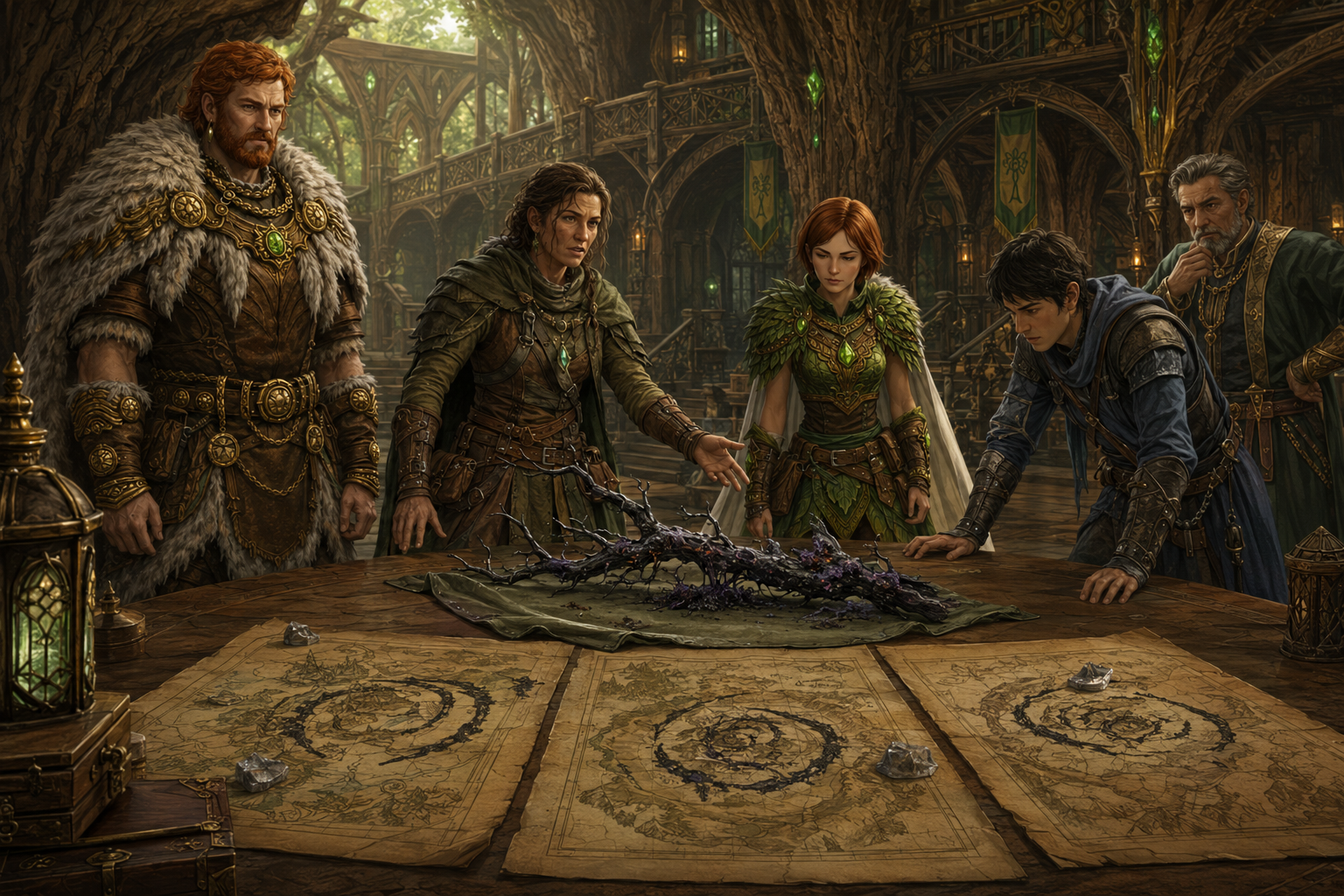
Master Tracker Ressa arrived at the Great Hall that afternoon carrying a dead branch wrapped in oilcloth.
She placed it in the centre of Panarf’s council table without greeting anyone.
Purple-grey moss covered one side. The other had split open and released a dark substance that hardened like resin where it touched the cloth.
“Found south of the third water trench,” she said.
Panarf’s jaw tightened. “How far south?”
“Nine kilometres farther than last autumn.”
Thrankal, who had been invited to hear the northern exploratory report was present for the tracker’s report, leaned away from the branch.
“That rate cannot be correct.”
“I measured it twice in case the land moved while I wasn’t looking.”
Blena smiled despite herself.
Ressa noticed her fully for the first time. “Chief’s daughter.”
“Master Tracker.”
“You got taller.”
“No, I didn’t.”
Ressa looked her up and down. “Then everyone else got shorter.”
She turned back to the table and opened a leather map case. Three maps of the northern territory were unrolled side by side. Each showed the Saviour Mountains, the mining roads and the southern edge of the Dereliction Lands.
Bands of black ink crossed them.
“These are confirmed contamination boundaries,” Ressa said. “First map was drawn thirty-two years ago. Second, twelve. Third, this season.”
Kaelen moved closer.
The boundaries did not form straight fronts. They curved across valleys and mountains, bending around some crystal fields and extending through others.
“They look like rings,” he said.
“Broken rings,” Ressa corrected. “Terrain interrupts them. Water slows them. Crystal growth changes their direction.”
Thrankal glanced at Panarf. “You showed me only the present map.”
“You came to discuss mines,” Panarf said. “You did not ask why they were empty.”
Ressa laid six small stones upon the oldest map. “These were the largest producing seams when the first boundary was drawn.” She added six pieces of grey crystal to the second. “These had been mostly depleted by the next survey.”
Then she traced the new contamination line.
It passed directly through the exhausted mines.
Kaelen thought of Alderat: the crystal-lined channels, the six gates and volcanic energy redirected beneath the mountain.
“The corruption follows the removed seams.”
“It advances fastest through them,” Ressa said. “Not always immediately. Sometimes the land remains unchanged for years after a mine closes. Then black growth appears at the deepest face and spreads through the tunnels.”
“Mining creates it,” Thrankal said.
“No.”
Ressa’s refusal was immediate.
“Then what does mining do?”
“Removes whatever was slowing it.”
Panarf folded his arms. “I told you the malformed crystals in the old branch held the growth back.”
“One branch is not proof,” Thrankal replied.
Ressa reached into her map case and removed a narrow metal box. Inside lay three crystal fragments. All were twisted, clouded and useless for ordinary power storage. Black residue coated the box around them but had left a clean space around each stone.
“Nine tests,” she said. “The material grows towards wood, cloth, bone and living plants. It slows before reaching crystal. High-quality crystals stop it best. Malformed ones still affect it.”
Kaelen bent nearer without touching them. “The crystals may be absorbing energy from it. Or changing its frequency,” he continued, thinking aloud. “If the contamination is not a substance alone but the result of energy moving through the substance.....I wish Anderix were here.”
Blena touched his arm. “Normal speed.”
He took a breath. “The black material may not be the cause. It may be what living things become after prolonged exposure to something else.”
“Exposure to what?” Panarf asked.
Kaelen studied the curved boundaries.
“A signal. A field. Repeated releases of energy from the same central point.”
Thrankal looked towards the maps. “You are proposing that the Dereliction Lands are being poisoned by a machine.”
“I am proposing that these curves resemble waves.”
Ressa nodded once. “There is more.”
From the bottom of the case she removed a much older map. Its leather had darkened and cracked along the edges. Most of the northern territory was blank. The Saviour Mountains were drawn as a line of white peaks. Beyond them, almost at the centre of the largest contamination circle, someone had marked a center point.
Kaelen forgot Thrankal was in the room.
“Where did you get that?”
“Northern Watch archive. It was catalogued as a patrol map, though no patrol route reaches the marked location.”
“Has anyone seen the what is at this point?”
Ressa did not answer immediately.
Panarf did.
“Yes and no.”
Blena looked at her father. “You knew there may be a cause of the dereliction?”
“I knew there were reports but no confirmation. The risk to life was too great just for knowledge of unknown possibilities, but there were factions that demanded we investigate.”
“That is a chief’s way of saying yes.”
Ressa placed four small tokens along the northern edge of the map.
“First expedition reached the outer band and returned ill. Second reached the black forest. Two Guardians attacked one another without knowing why. Third expedition saw the rings around the point from a ridge and lost half its people returning.”
She placed the fourth token nearer the centre.
“The last group entered twelve years ago.”
“And?” Kaelen asked.
“One person returned.”
“What did they see?”
“Nothing we could trust. She spoke of circles in the air. Light travelling beneath the ground. She beleives that she saw a structure that looked close no matter how long they walked.”
Blena stared at the final token. “Who returned?”
A voice answered from the open balcony.
“I did.”
The woman who entered wore a Guardian’s ash-brown fur with one sleeve pinned above the elbow. Burn scars crossed the right side of her face and disappeared beneath her collar. A narrow flame crystal hung from an iron chain at her throat.
Blena went completely still.
The woman looked at her, and something almost like amusement disturbed the scarred corner of her mouth.
“You still stand with too much weight on the front foot.”
Blena shifted before realizing she had obeyed.
“Flame Master Varda.”
Varda took in Blena’s foreign armour, repaired shield and weathered travelling cloak.
“Two years wandering the world,” she said, “and you still make yourself easy to knock over.”
“People have tried.”
“Though I am glad to see you still wear your Ironroot colours and weapons.”
Panarf gestured towards the map. “Varda trained the northern shield companies before the expedition.”
“She trained me,” Blena said.
“Attempted to,” Varda corrected. “You were talented, impatient and convinced pain was evidence of progress.”
“It often is.”
“So is death. But we avoid using it as a lesson on young guardians and mages.”
Kaelen saw Blena’s mouth tighten, not in anger but in the effort not to smile.
Varda placed her remaining hand on the old map.
“The structure is real,” she said. “The light is real. The closer we came, the less we remained ourselves. We argued. We heard voices no one else could hear. One Guardian became convinced black insects were beneath his skin and tried to remove them with a knife. Another walked into a poisoned pool because she said her mother was calling from the water.”
The room had become very quiet.
“How did you survive?” Alster would have asked. Kaelen heard the absent healer’s voice so clearly that for a moment he expected him to step forward.
Instead Blena asked it.
Varda touched the empty sleeve.
“I burned the corruption from my arm before it reached my chest.”
Blena looked at the flame crystal.
“You cut it off?”
“Not quickly enough.”
“Why don’t you share that experience with the young trainees. It could be useful to them if they contacted the Dereliction. And your belief about a structure... it could be something?” Blena knowing what she knew now was trying to make sense of it.
“Its not the kind of story you share with a child even if they are training to be a warrior. Besides, how do you think we know about water slowing the spread of plants and animals that have the Dereliction? That is all from the sacrifices of those who ventured north.”
Kaelen studied the centre of the painted rings. “You believe the center of this map causes the Dereliction, and you think it is a structure..”
“I believe every poisoned band bends around it,” Varda replied. “I believe light moved from it each time our minds worsened. And I believe whatever lives or works inside it has been calling into empty country for longer than Ironroot has kept records.”
Thrankal rose from his chair. “If this place is connected to the crystal failure, the Council must be informed.”
Blena turned on him. “So you can send another group of deniable children?”
“So qualified people can investigate.”
“Qualified people already did.” Varda tapped the place where her arm ended. “The tower kept its findings.”
Kaelen looked across the maps: the empty mines, the advancing bands, the black growth parting around broken crystals and something at the centre of the circle.
Alderat had regulated volcanic energy. Alfadin had redirected water. Helion had gathered sunlight. The ancient builders had used the forces of each place rather than imposing one design upon all of them.
What had the northern tower been built to control or contain?
Blena was looking at the same symbol.
Panarf saw it happen.
“No,” he said.
She did not look at him. “I haven’t said anything.”
“You do not need to.”
“If there is a tower up there and it is causing the corruption...”
“Four expeditions entered. One person returned.”
Varda lifted her scarred face. “And I did not reach the centre.”
Kaelen placed one finger near the centre of the painted circles.
“Then no one has investigated the structure itself.”
Panarf looked from him to his daughter.
The relief of the previous night had left his face. In its place stood the Chief who had warned that belief was not his only duty.
“You came home this morning,” he said to Blena.
“Yesterday.”
“That is not where I am going with this and you know it.”
Blena finally met his eyes.
“You said Ironroot needed what I learned outside its forests.”
“I did not mean that you should walk into the Dereliction before finishing breakfast.”
“It is well after breakfast.”
Varda’s scarred mouth moved again.
Panarf noticed. “Do not encourage her.”
“I said nothing chief.”
“You trained her. Your silence is suspicious.”
Kaelen rolled the newest contamination map over the old one. The circles almost aligned. The newest boundary pushed south through the empty mines like water finding cracks in a wall.
“If Ressa is right, every crystal removed makes the containment weaker,” he said. “If Thrankal expands the mines, the spread could accelerate. If mining stops, the crystal shortage worsens. We cannot solve either problem without knowing what the tower is doing.”
Thrankal straightened his cloak. “At last, a practical conclusion.” Then he turned to Blena. “And a most necessary one, wouldn’t you agree?”
Blena placed her hand over the centre symbol.
“How long to reach it?” she asked Varda.
“If the old route remains passable, six days beyond the northern watch.”
“And if it doesn’t?”
“Then you will die somewhere else.”
Panarf closed his eyes.
For the first time since entering Karvok, Blena looked entirely at home.
That frightened Kaelen more than the map.
Outside the open hall, wind moved across the suspended bridges. Far to the north, beyond the white line of the Saviour Mountains, something too distant to be thunder rolled through the forest, malformed crystals beside it answered with a faint blue light.
Thy Quest: Follow the Evidence
Ressa and Varda present several clues that the northern structure is connected to the spreading Dereliction. Explain which piece of evidence makes the strongest connection and why. Use two other details from the chapter, including one that could support a different explanation.
Continue to Quest 3
Return to Bordrad with Blena and Kaelen as they prepare for the journey north.