Quest 3: A Matter of Concern
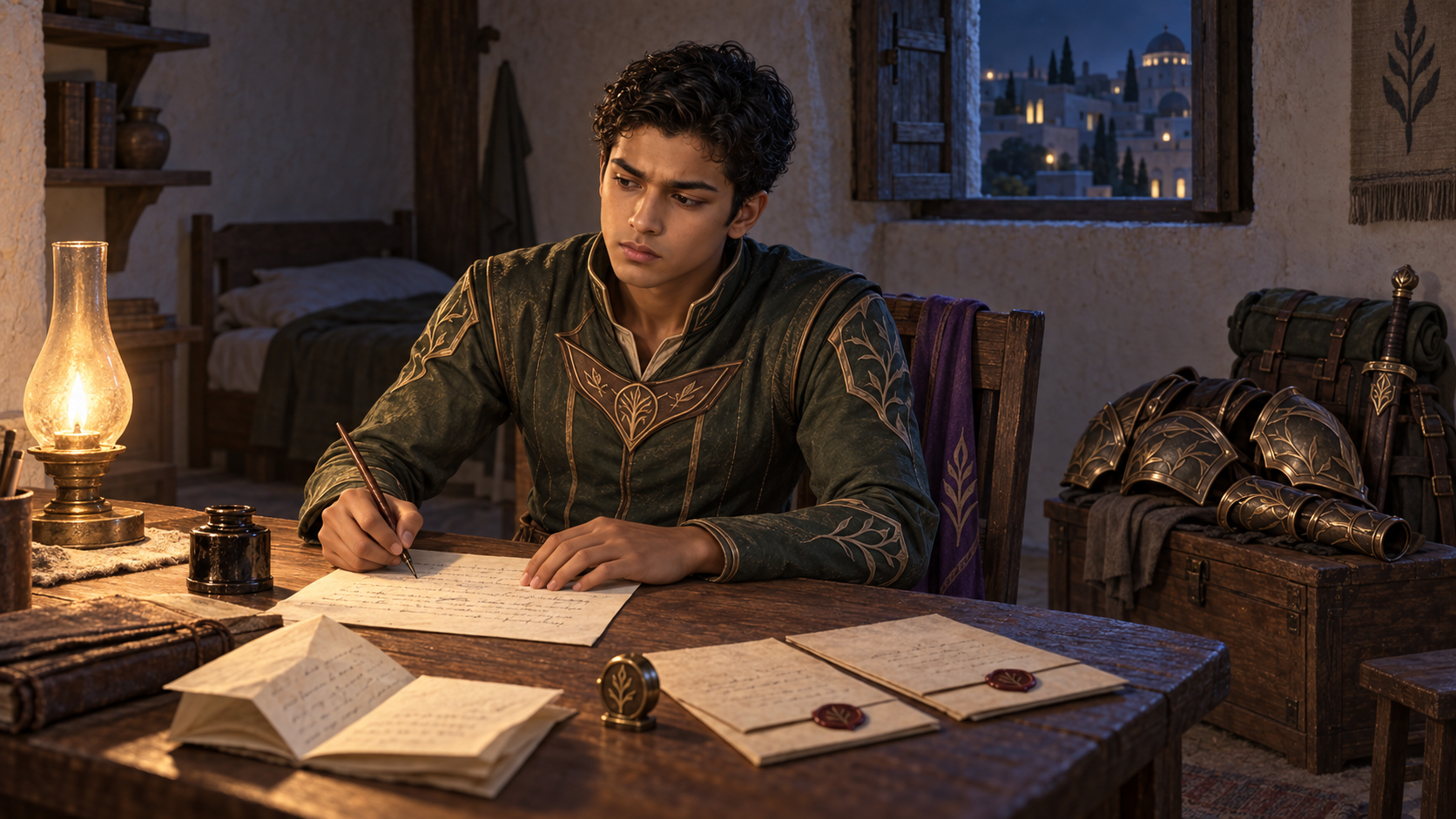
A Matter of Concern
Over the following weeks, the petitions changed.
At first they had requested restoration of customary allocations. Then they asked for enough to maintain essential services. Eventually they named particular wells, wards and stretches of road.
The Virielian representative brought a healer to one of the morning audiences. She carried no gift.
“We can manage wounds without accelerated healing,” she told Delrona. “We can set bones. We can clean, stitch, brew and blend and then wait. But every patient who must remain three weeks occupies a bed needed by somebody else.”
“Our additional extraction is intended to relieve precisely that difficulty.”
“When can we obtain a consignment?”
“The present yield is committed.”
“That was the answer last week.”
“It remains the present yield.”
At the next audience, an Emberwild officer spread a patrol map across the same table. Whole sections of the route had been crossed out.
“If we take fewer crystals, we cannot reach the northern posts and return with a defensive reserve.”
“Ask your mages to support the shields with their crystals,” Menard suggested.
The officer brought forward a rider whose cloak hung loosely around her shoulders.
“We already have and now our mages are reduced to simple casts and lack the power to perform more significant work.”
She looked directly at Menard.
“Giffons fly in shorter stints and with less energy when their riders carry lower charged crystals. The entire network faces delays in messages that aren’t meeting deadlines.”
“I understood riders could let griffons draw upon their own strength.”
“So can a man carrying a wounded friend. Eventually he falls down.”
Rahkhan moved a chair towards her. She accepted it without the little refusal people made when they wished to appear strong.
Fateese collected their requests, carried them into Delrona’s private room and returned with revised dates.
That afternoon he took a different set of papers to the Council chamber. At supper he brought two ambassadors through a side entrance. The next morning the Thalorian charging period had been extended.
Rahkhan could no longer look at a new date without wondering whom Fateese had seen the night before.
* * *
The proposed Voice Casting came to Delrona’s attention because the organisers requested a modest power allocation which the Council had already refused.
Selvara placed their application beside her breakfast.
“Shared Systems: Crestrealm Knowledge and the Crystal Shortage,” Delrona read.
Fateese reached for the honey.
“An ambitious title before breakfast.”
“Who is speaking?”
“A Virielian healer, an Ironroot surveyor and a Solaryn scholar studying the old solar installations,” Selvara said. “A Kefarian cradle technician is to answer questions. They have requested a contribution from Mechanum, but no acceptance is recorded.”
“There is no surprise about the Mechanum refusal but what do they intend to discuss?”
“Comparisons between regional failures. Shared measurements. Whether recent discoveries concerning ancient installations should be exchanged between Crestrealms.”
Delrona turned the page.
“Who authorised it?”
“The Amphitheatre accepted the programme before the new arrangements.”
“Then the arrangements should be explained to them.”
Rahkhan stood beside the window. Below, people were carrying empty crystal cases towards the charging house.
“Might their observations help the investigation?” he asked.
“Observations can be submitted in writing.”
“They want to compare them.”
“Then they may do so through the appointed office.”
Delrona slid the programme back to Selvara.
“We have just spent weeks persuading people that supply is being brought under control. Now an audience is to be told that unknown systems connect every Crestrealm and that anyone with a theory should be allowed to examine them.”
“It does not say that,” Rahkhan said.
She looked at him.
He resisted the urge to lower his eyes.
“It asks whether sharing measurements would help.”
“And who in the square will hear the distinction? There has already been violence in these streets. We will not lend the Exchange’s authority to dangerous propaganda disguised as a discussion.”
Fateese put down the honey.
“A postponement on conservation grounds?”
“Suspend nonessential Voice Castings until their subjects and speakers have been reviewed. Official notices and safety instructions may continue.”
“Through whose review?”
Delrona waited.
He nodded and reached for his tablet.
The organiser came in person after receiving the notice. Rahkhan admitted him late in the afternoon, when the day’s warmth had thickened the smell of wax in the reception room.
“We can speak without amplification,” the man said. “No crystals. The upper tiers may have difficulty hearing, but we have held debates that way before.”
Delrona glanced at the notice he carried.
“The suspension concerns the event as well as its power allocation.”
“We have guests who travelled here.”
“They may submit their papers.”
“To people who already have them.”
“Then there will be no difficulty locating them.”
The man folded the notice carefully.
“Six years ago, you objected to the Council deciding what people should hear.”
Fateese became very still beside the desk.
“Six years ago,” Delrona said, “I objected to what the Council was saying.”
The organiser looked towards Rahkhan, perhaps hoping for something the uniform promised.
Rahkhan could offer him only the open door.
That evening, the Exchange announced the suspension in a Voice Casting that could be heard all the way down to the harbour.
* * *
The Senate’s reply arrived three days later.
Unon acknowledged the restored Sylvan deliveries before addressing anything else.
The relief is real, he had written. Several colleagues who opposed her appointment now regard its success as settled. Any charge you bring will be examined in that light.
Rahkhan read the next passage twice.
An armed establishment paid, supplied and commanded through her private interests would exceed the mandate. Establish whose contracts bind these Guardians, who pays them, and whose orders they must obey. Their origins do not establish their allegiance.
Regarding the meetings, Unon had underlined one sentence.
Record the distinction between a decision you witnessed and a connection you suspect.
There was no instruction to recall Delrona. No assurance that the Senate would act. Unon asked for copies where Rahkhan could lawfully obtain them, names of witnesses and confirmation of the money behind the northern force.
At the bottom he had added a shorter note.
You were not sent to find her innocent or guilty. Keep an account that another person can test. Continue to protect her.
Rahkhan folded the letter along its original creases.
Outside his window, two Sylvan porters were arguing cheerfully over the best way to stack the next relief consignment. He recognised the accent of the younger one. It came from the river settlements near his home.
He listened until the argument ended, then opened his notebook.
* * *
The Rider arrived after the last petitioner had gone, with salt dried white along the shoulders of his cloak.
Rahkhan had been sent to confirm the next Sylvan consignment. Fateese admitted the man through the side entrance and shut the door behind him.
“From Ironroot?” Delrona asked.
“By the coastal relay. The High Councillor is preparing to leave Karvok. His people have requested passage home.”
“Has he concluded his business with Chief Panarf?”
“The message did not say.”
“But you read it.”
The Rider glanced at Fateese.
“I was asked to remember anything concerning his movements.”
“And you have remembered very well,” Delrona said.
Fateese placed a small purse upon the table. The Rider covered it with his hand, felt its weight and put it inside his cloak.
“His departure?” Delrona asked.
“Within days, if the northern weather permits. Two ships have already delayed their sailings.”
“Continue to keep us informed.”
When he had gone, Delrona remained at the window. Evening light lay across the harbour, turning the wet roofs pale gold.
“Thrankal will expect his chair to be exactly where he left it,” Fateese said.
“His chair has not moved.”
“No. Several other things have.”
She watched a vessel being drawn away from the quay.
“There is a storm expected in the northern ocean.”
“So our friend mentioned.”
“I fear for the High Councillor’s safety. A man accustomed to having every room obey him may find the sea less accommodating.”
Fateese waited.
“It would be a terrible thing,” she continued, “for him to come so far and never reach Kefar.”
“Shall I ask that he be warned?”
Delrona turned from the window.
“I think you should speak to Drell. He has people who understand these crossings.”
Fateese’s fingers rested on the edge of his writing tablet.
Then he put it away.
“I shall convey your concern.”
Drell was in the warehouse office, checking equipment returns beneath a lamp that smelled of hot oil. He listened without interrupting, then dismissed the clerk sitting opposite him.
“The ambassador fears the weather?” he asked when they were alone.
“For Thrankal.”
“And his return?”
Fateese pulled his coat straight.
“She would prefer not to have cause to fear that as well.”
Drell looked at him for a moment.
Outside, a porter shouted for help with a heavy crate. Neither man turned towards the sound.
“There will be questions,” Drell said.
“There are always questions. She employs a considerable number of people to answer them.”
After Fateese left, Drell called in a man who had been waiting beside the loading doors. His sea cloak dripped onto the office floor.
“The High Councillor is coming home from Ironroot,” Drell told him. “Our friends on the northern passage are to take an interest.”
“What sort of interest?”
“The ambassador is concerned he may be lost overboard in the coming storm.”
The man stopped unfastening his cloak.
“May be?”
Drell closed the equipment ledger.
“When you return, I expect that uncertainty to have been settled.”
The man nodded once.
“An unfortunate crossing.”
“For the High Councillor,” Drell said.
He waited until the door had closed before calling the clerk back to finish the inventory.
* * *
The Council approved the Solaryn emergency allocation on a wet morning when rain ran down the chamber windows in broad, wavering sheets.
The ambassador stood beside a map of the drought districts.
“These wells have water below the present lifting depth,” she explained. “The machinery is sound. We need charged stones to operate it.”
Councillor Dilahk bent towards the map.
“And the surface reservoirs?”
“Two empty. The third will not last until the next scheduled Primary arrives.”
Menard asked how many people depended upon them.
She told him.
For once, nobody began discussing procedure.
The administrator proposed twelve cases from the Council’s emergency reserve: enough for the lifting machinery, the district healing houses and the mages maintaining the most vulnerable channels.
The motion passed.
Rahkhan heard Menard announce it. He saw the administrator sign the release. Delrona, seated at her usual place, made no objection and other ambassadors applauded the decision.
Afterwards the Solaryn ambassador stood beneath the portico looking out at the rain.
“I should like to send some of that home as well,” she said.
Rahkhan smiled.
“The cases will help.”
“Yes.” She let herself breathe out. “They will.”
Fateese came to collect Delrona. Menard’s clerk was waiting at the side door with a second set of papers.
“A transport matter,” Delrona told Rahkhan. “Remain here.”
He watched them enter the private room. Fateese went in behind Menard and closed the door.
He recorded the meeting later because Unon had asked him to record such things.
He had no reason, yet, to attach the Solaryn allocation to it.
The following morning Maerith asked him to accompany an inspection of northern supplies at the harbour.
The warehouse smelled of wet rope, packing straw and fresh-cut wood. Rainwater dripped through a split in the roof into a bucket that someone had placed too far to one side. Porters moved around it without looking down.
The large Alfadin reserve crystals stood in their travelling frames behind a locked barrier. Beyond them, a clerk was checking smaller cases against a list.
Rahkhan stopped beside a stack near the loading doors.
One lid bore a fresh Verdant destination mark.
Beneath it, scratched through but still readable, was the Solaryn district named at the Council meeting.
“These are in the wrong stack.”
The clerk checked his list.
“No, Guardian. Revised destination.”
“There were twelve cases.”
“Twelve here.”
Rahkhan held out his hand.
The clerk hesitated, then gave him the order.
Menard’s seal occupied the lower corner. The wording described an urgent operational reallocation to support expanded crystal extraction in the Verdant Expanse. Delivery would be made to the lifting and drainage works serving Delrona’s concession.
“The Council approved these for drought relief.”
“That is what the first paper said.”
“Who brought this one?”
“A clerk from the Council.”
“Fateese?”
The man shook his head. “Don’t know his name.”
Maerith came over.
“Is something damaged?”
“These cases were promised to Solaryn.”
“The destination was amended.”
“By whom?”
She looked at the order in his hand.
“Councillor Menard.”
“Did the ambassador request it?”
“You would have to ask her.”
Maerith’s answer was neither frightened nor evasive. Rahkhan could not tell whether she knew anything beyond what he held.
“The irrigation machinery cannot wait for the mine to produce a return.”
“I am checking stores, Guardian. I do not determine Council policy.”
Behind her, Drell inspected the locks on the Alfadin reserve. Two recruits followed him, their new crystals bright against their belts.
Rahkhan copied the amended order’s number before returning it.
The clerk waited until Maerith had moved away.
“Will you stop the loading?”
Rahkhan looked at the seal again.
His commission gave him no authority to seize Council cargo. If he drew his weapon here, the men securing those cases would be obliged to oppose him, and Delrona would receive a report about an unstable young escort interfering with emergency work.
“Keep the original release with the amendment,” he said. “Both of them.”
“They usually take away the superseded copy.”
“Has anyone taken it?”
“Not yet.”
“Then record that you acted on two different instructions.”
The clerk looked towards the office, then nodded.
* * *
Menard received Rahkhan standing beside a table crowded with dispatches.
“The relief has not been cancelled.”
“Its supplies are being loaded for Verdant.”
“Its immediate allocation has been deferred.”
“Until when?”
“Until replacement stock becomes available.”
Rahkhan kept his hands at his sides.
“The Council heard how long those wells could wait.”
Menard pressed two fingers against his temple.
“And the Council has entrusted emergency administration to those capable of responding as circumstances change. The Verdant workings require power to clear flooded galleries and lift material. Without that work there will be fewer crystals for everyone, including Solaryn.”
“Was that known when the vote was taken?”
Menard lowered his hand.
“What precisely are you asking?”
“Whether new information arrived afterwards.”
“Operational advice.”
“From the ambassador?”
“From those concerned with extraction.”
“May I see it?”
“You may ask your ambassador whether examining Kefarian administrative correspondence forms part of your protection duties, Guardian.”
Rahkhan bowed because he could think of nothing else he could safely do.
Delrona was at the reception-room table when he returned. She had been comparing two lists of northern stores. Fateese stood beside her with his travelling coat already fastened.
“The Solaryn cases,” Rahkhan began.
“Menard has explained the amendment.”
He stopped.
Fateese adjusted one cuff.
“He sent word that you had questions,” Delrona added.
“I do.”
She laid down the lists.
“Then ask them.”
“Did you request the diversion?”
“I provided the Council with the requirements of the extraction programme. Menard issued the order.”
“Those requirements sent power to your mine.”
“The mine producing the stones you carried into a healing house.”
“I remember.”
“Do you remember what the healer did with them?”
“Yes.”
“Then you understand why production must increase.”
Rahkhan looked at the lists beneath her hand.
“People are waiting for water.”
“People were waiting for water before I arrived. They were waiting for treatment, patrols and replacement crystals. You saw that yourself.”
“There were twelve cases they would not have had to wait for.”
Delrona sat back. “Rahkhan, I am beginning to feel you don’t see the good in what I am doing here.”
Fateese’s hand stopped at his cuff.
“Do you think I can restore a failing system without deciding where its remaining power will do the most good?” she asked.
Rahkhan thought of the girl carried back from the bridge. Of the mage lowering herself into a chair. Of the Sylvan shipmaster expecting people all along the road.
“I think the Council had made that decision.”
“And Councillor Menard amended it. If you disagree with his authority, you must address that to him.”
She drew the northern schedules towards her again.
“Fateese, the harbour papers before you leave.”
He placed them beside her.
Rahkhan remained by the door while she signed. He watched each sheet pass from her hand to Fateese’s, but none concerned the twelve cases.
* * *
The Solaryn ambassador was waiting outside the stores office when Rahkhan found her.
The administrator had brought out two chairs. Neither woman was sitting.
“Can you confirm it?” the ambassador asked him.
He nodded.
“They are loading for Verdant.”
She looked down at the original Council notice in her hand.
“I sent word yesterday.”
Rahkhan did not answer.
“I told them it had passed. I thought I could finally send something better than another explanation.”
The administrator took off her lenses and rubbed the marks they had left beside her nose.
“I will certify a copy of the original release,” she said. “And the amended order, if the harbour has retained it.”
“They have,” Rahkhan told her.
She studied him briefly, then went inside.
The ambassador smoothed the paper against her palm. The action did nothing to remove its creases.
“Do you know why they changed it?”
He could have told her about the private room. About Fateese’s tablet, the appointments and the dinner at which her question about wages had ended her audience.
He could not tell her which of those things had produced Menard’s order.
“I know where the cases are going,” he said. “I am trying to establish who requested it.”
She looked at his purple sash.
“Then please keep trying.”
That night, Rahkhan began a second report to Unon.
He copied the Council decision, its date and the names of those present. Beneath it he recorded the amended order, the destination and the concession that would receive the power. He listed the people he had seen enter Menard’s private room and stated plainly that he had not attended their meeting.
The first certified copy lay beside his elbow. The second had been promised in the morning.
Beyond the window, a Voice Casting announced that further northern investigative preparations had been approved. The speaker praised the cooperation between Kefar and the Sylvan Watch. Somewhere below, someone called for the announcement to be repeated.
Rahkhan waited for the voice to finish before writing the last paragraph.
The ambassador’s intervention has restored supplies to our people. I have seen the benefit and do not withdraw that part of my first account.
He paused, listening to a cart pass beneath the window.
I can now document an emergency allocation being reversed in favour of her commercial interests. I cannot yet establish that she directed the reversal.
He read both sentences, then added one more.
I request that the Senate preserve the original contracts for the Guardians now serving under Drell, and obtain the instructions under which they were recruited.
Rahkhan left room for the second certified order and set his seal beside the unfinished packet.
Tomorrow he would stand at Delrona’s door again.
Before that, he would be at the harbour when the records office opened.
Thy Quest
The reader hears private conversations that Rahkhan does not. Choose one example and explain how this changes your understanding of events. Then identify one fact Rahkhan can prove and one connection he still suspects. Why does that distinction matter in his report to Unon?
Continue to Quest 4: What the Fire Kept
Delrona turns stolen knowledge into a plan for conquest, convinced that her command of four elements can overcome the ancient network’s warning.