Quest 1: What We Carry
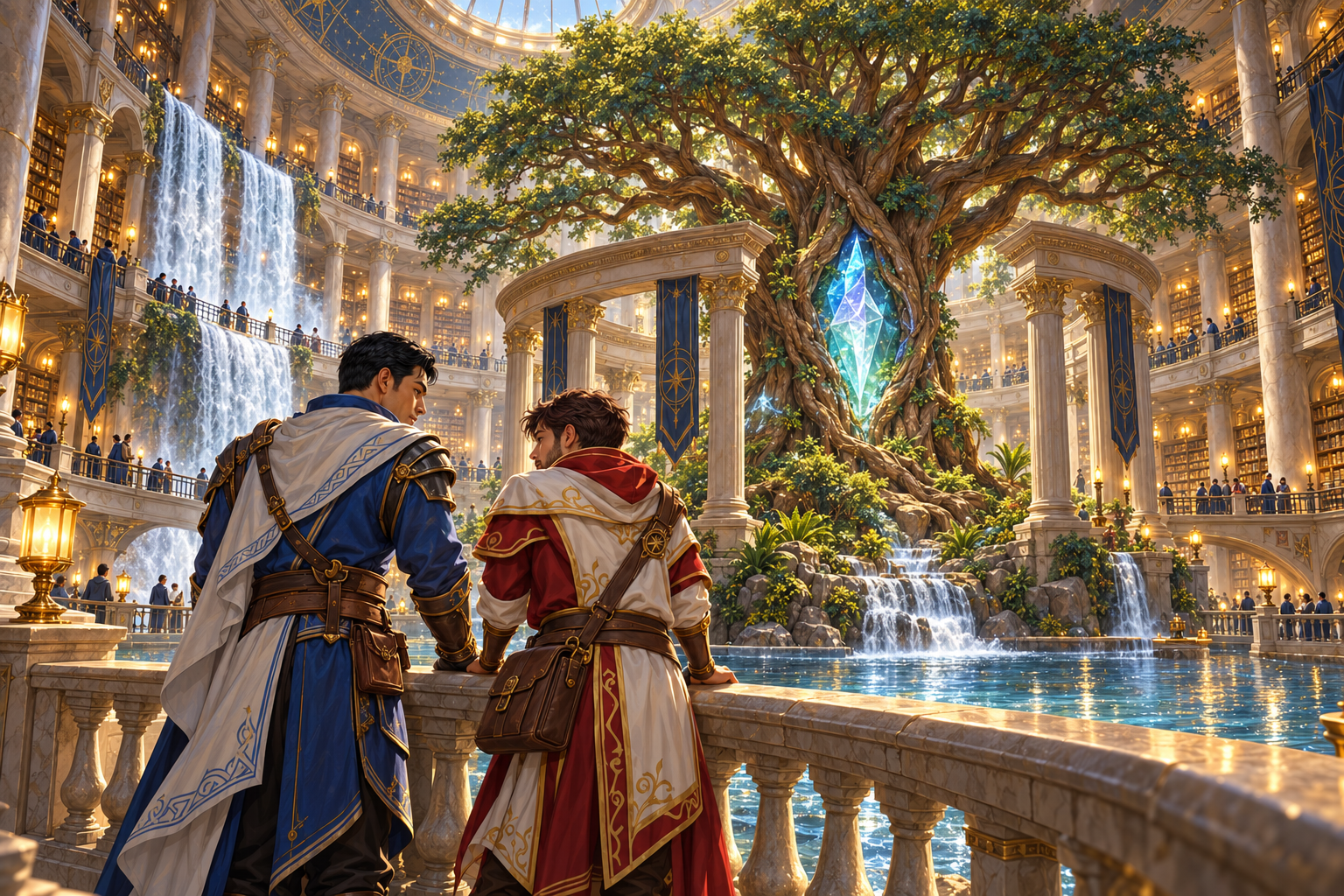
What We Carry
“Stop pulling at it.”
“It scratches. And what are you? My mother?”
“It is a beard, Alster. That itch is among facial hair's biggest vexations. And I am more like a brother, actually. Or, if you do something stupid, a father.”
Alster lowered his hand.
Across the courtyard, a woman in long pale robes watched them from beneath the library portico. She had been watching since Drue brought Dasher down outside the northern wall. Two Guardians stood behind her, their staffs planted upon the stone.
“Does it make me look older?” Alster asked.
“It makes you look as though you have spent several weeks regretting a beard.”
“Helpful.”
Drue reached across and straightened the borrowed collar. His fingers lingered beneath Alster’s jaw.
“Look at me.”
Alster did.
“Your papers are in the left pocket. Your letter is inside them. Let her read before you explain.”
“Why, thank you, Father. Am I ready for school now, sir?”
“You knew what to do at the last gate, but you panicked and made things much worse.”
“That man asked unnecessary questions. These Astryx are so obsessed with locking every door and window before going outside that they never actually get outside.”
“There you go blaming someone else again. Just try following my advice for once. The last one only asked your name, and you started babbling.”
Alster’s mouth moved almost into a smile. “Babble, babble!”
Drue brushed a loose thread from his shoulder and stepped back.
“All right. You look ready. Now get on with it.”
Beyond the portico, Luminary Prime climbed the pale hillside in terraces of sandstone. Narrow windows of fine crystal glass reflected the pink in the morning sky. There were no market cries here, no carts arguing their way through pedestrians. A bell sounded somewhere above them, and the few people crossing the courtyard stopped until its final note faded.
The quiet unsettled Alster. His heart was already racing when he needed it steady. He waited with the others, listening to the reverberations diminish. By the time they ceased, his breathing had slowed.
Drue noticed. After weeks of travelling together, he had learned how much effort it cost Alster to stand still.
The woman extended her hand.
“Your papers.”
Alster gave her the packet.
She examined the seal, read the letter, then looked at him.
“Plant Master Skan of the Virielian Bloomlands.”
“Yes.”
“You are younger than I expected.”
“People keep telling him that,” Drue said.
Her eyes shifted to him.
“And you?”
“His assistant.”
“Your name.”
“Drue.”
She returned her attention to the letter.
“Your government requests access to writings concerning preservation, crystalline memory and extensions of life.”
“That is correct,” Alster said.
“Which discipline informs your inquiry?”
“Healing.”
“Which patient?”
Alster’s fingers closed against his coat.
“Must every question concern a patient?”
“No. But yours does, Master Skan.”
Drue saw the answer forming and touched Alster’s elbow. A gentle squeeze offered both warning and reassurance.
“We have travelled a considerable distance,” Alster said. “May we complete whatever examination is required?”
The woman folded the letter.
“Travel establishes persistence and dedication. We honour both. But the distance you have travelled cannot establish your readiness for what you seek.”
She turned towards the doors.
“Leave your crystals with the Guardian.”
Alster did not move.
“All of them?” he asked.
“All of them.”
Drue began unfastening his pouch.
“Come on,” he said quietly.
Alster watched him hand it over. Then, reluctantly, he did the same.
• • •
The first passage had no rail.
It crossed a deep chamber on a strip of stone scarcely wider than their shoulders. Far below, shelves followed the walls into darkness. A narrow channel ran down the centre of the crossing. At the near end stood a large bucket filled to its rim with water.
Their examiner pointed to it.
“Bring the water to the other side and heed my call.”
Drue looked at the bucket, then at the crossing.
“Is there a more convenient side?”
“No.”
They took opposite handles and lifted it between them.
At the first step, water spilled over Alster’s fingers.
“Slower,” Drue said.
Alster stopped. The spilled water had fallen into the channel and was running ahead of them. He watched it disappear beneath the edge of a paving stone.
“Heed my call,” he murmured.
“What?”
“Something Master Skan used to recite.”
Skan often spoke of the essence of life found in water and the care it deserved. He claimed the verse was as old as time, though Alster had never heard him attribute it to anyone.
Guard the water, waste it not;
Yet life must drink what you have brought.
Take heed to share its bounty with all,
That root and leaf may heed the call.
Alster looked along the channel.
“Share its bounty,” he said.
“I would prefer to share it somewhere with a rail.”
“Just a little. Help me tip it.”
“Are you sure?”
“No. But I want to see where it goes.”
They lowered one side of the bucket. A thin stream entered the channel and hurried ahead.
Halfway across, a square stone pillar blocked most of the passage. On either side, a lip of stone offered room for toes, but little more. The channel led into a shallow basin at its base.
They carried the bucket forward and set it down before the obstruction.
Alster turned his shoulder towards the narrow gap.
“I might get through sideways.”
“With the bucket?”
Alster looked at the water, then down into the chamber.
“Perhaps not.”
Drue crouched beside the pillar. A clean seam ran around its base. Beyond it, two parallel grooves led towards a recess in the chamber wall.
“Unusual construction, don’t you think?” he said.
Alster followed his gaze.
“A track?”
“Possibly.”
They stood beside each other and pushed. Nothing moved.
Drue stepped back, rubbing his palms.
“Either I am wrong, or the library expects stronger scholars.”
Alster crouched beside the basin. The water they had spilled barely covered its bottom. Near the pillar, a small opening revealed a pale wooden block beneath a slender metal rod.
“Look.”
Drue knelt beside him.
“The wood will float,” Alster said.
“And lift that rod.” Drue leaned closer. “There is something holding the pillar in place.”
They lifted the bucket and poured a little more into the channel. Water spread through the basin. The wooden block rose slowly, carrying the rod with it.
A click sounded inside the stone.
Both looked up.
“That seems encouraging,” Drue said.
They set the bucket down and braced their hands against the pillar.
“What is the worst thing that could happen?” Alster asked.
“We could fail the test and be denied entry, I suppose.”
“I did not want you to actually tell me.”
They pushed.
The pillar shifted with a low scrape. Alster’s feet slipped, and Drue caught his shoulder before he could stumble backwards.
“Together,” Drue said. “On three.”
This time they planted their feet firmly and pushed in one sustained effort. Their arms trembled, but the stone began to roll along its concealed track.
As it moved, a narrow gap appeared between its top and the ceiling.
“It was never holding anything up,” Alster said through clenched teeth.
“Except us.”
They paused to catch their breath, then pushed again. The pillar slid into the recess in the wall, leaving the crossing clear.
“I am fairly sure this is part of the test,” Drue said.
Alster bent over the bucket.
“Come on. Before they find us another pillar.”
They took the handles and carried the remaining water across.
At the far end, Alster set the bucket down harder than he intended. Water slapped against its sides, but stayed within the rim.
Their examiner inspected it.
“Why did you surrender part of what you were told to carry?”
“Because keeping all of it would have stopped us bringing any of it,” Alster said.
“And what brought the remainder here?”
“Cooperation,” Drue said.
Alster looked back towards the pillar.
“And knowing when to change our approach.”
She nodded.
“Both were needed.”
She gestured towards a second door.
Inside waited two chairs and an unlit crystal tablet.
“Why have you come?” she asked.
Alster glanced at Drue.
“To study.”
“That is what you intend to do. Why will you do it?”
The silence lasted long enough for the water on his hands to dry.
“My brother died,” Alster said.
Drue’s gaze remained on him. For a moment, he wanted to reach across and touch Alster’s arm. Instead, he let him speak.
“I want to understand what remains of a person.”
The examiner touched the tablet. Light gathered beneath her fingers.
“And you?”
“To help him,” Drue said.
“With his inquiry?”
“With whatever happens when it ends.”
Alster turned towards him.
The examiner took them up a narrow stone stairwell and opened a door to a hallway much wider and impressive then down to a very wide formal marble entry hall. She hushed them and opened the inner door.
• • •
Alster stopped beneath the archway.
For a moment, he could not make sense of the room’s size.
Across the chamber, people leaned over the railings of galleries so distant that he could scarcely distinguish their faces. Above them rose another level of shelves, then another, each carried upon pale columns and joined by arches. He followed them upwards until his neck began to ache.
A dome enclosed it all. Fine golden lines crossed its deep blue surface, tracing constellations and circles whose purpose he could not guess. At its summit, daylight entered through a crown of glass.
Beneath that light stood the tree.
Its trunk rose from an island at the centre of the library, broad enough that a dozen people joining hands might not have encircled it. Great limbs divided above a ring of marble columns and spread towards the upper galleries. Smaller branches crossed and overlapped beneath the dome, their leaves shifting in a current of air Alster could not feel.
He had seen ancient trees in Virielia. He had climbed among their roots and rested beneath crowns that sheltered entire gardens.
He had never seen one housed like this.
The library appeared to have made room for every stage of its growth. The central portico curved around the trunk in two open sections, leaving space for its branches to reach between them. Roots gripped the planted island, folding over dark stone and disappearing among ferns. Several had thickened against the bases of the columns. The marble there had been cut back, carefully, to accommodate them.
Water fell beside the tree.
Alster had heard it before the inner door opened, but had mistaken the sound for wind. Now he saw the waterfall descending from a high channel near the galleries. It passed behind a narrow bridge, broke upon a ledge, and fell again into the basin surrounding the island.
Mist hung close to the stone. Smaller streams emerged between the roots and spilled down into the same pool.
The water was blue where daylight reached it and almost black beneath the portico. Ripples carried the reflections of columns towards a low balustrade, where they broke into trembling fragments of white and gold.
Beyond the basin, the reading floors remained dry.
Desks followed its curve in broad rows, each furnished with a brass lamp. Some held a single open volume; others had disappeared beneath careful piles of books, loose papers and narrow wooden cases. Robed scholars bent over their work. A woman crossed between the desks carrying a stack against her chest. On a lower gallery, someone climbed a short ladder and drew a book from a shelf.
There were hundreds of people here.
Perhaps more.
Yet the waterfall filled the chamber without drowning the smaller sounds. Alster could hear a chair move nearby, the turn of a page, a brief exchange at one of the desks. High above, a figure crossed an arched walkway and vanished into the shelves.
Drue came beside him.
“Well,” he said, very softly. “That explains the door.”
Alster scarcely heard him.
A crystal shone within the tree.
It was set deep in the trunk, taller than either of them, its lower point held among folds of wood. The bark had grown around its edges in thick, uneven ridges. On one side, a narrow strip of living wood crossed a facet before joining the trunk again.
Alster stepped forward.
From the doorway, the crystal had looked blue. As he moved, a pale green light appeared within it, followed by something almost violet in its depths. Its surface caught the warm reflections of the library lamps, but the light beneath them remained cool.
A slow brightening passed through it.
Alster watched the bark above the opening. For an instant, fine lines showed beneath its surface, following the grain towards the first division of the trunk. Then they faded.
Among the branches, a handful of leaves glimmered.
He waited.
The crystal dimmed, though it never went dark. Water ran between the roots. Somewhere behind him, the inner door closed.
Then the light gathered again.
Drue followed his gaze.
“That is inside it,” he murmured.
Alster nodded.
He tried to imagine the tree when it had first reached the crystal. A young trunk bending around an obstacle. Wood thickening year by year, finding space along the facets, roots closing beneath the point.
Or perhaps the crystal had been placed there later.
He could see no cut in the bark. No fastening. Nothing that explained where one ended and the other began.
Above them, the crown stirred.
Drue looked from the tree to the archway through which they had entered.
“How did they get it through there?”
A voice answered from the tree.
“The door predates the present dimensions of the crown.”
Drue looked around.
His eyes went first to the portico, then to the nearest desks. A scholar continued writing. Another reached for a lamp and adjusted its shade. Neither appeared to have spoken.
Alster was still watching the crystal.
The voice had carried clearly across the water, though it had not been raised.
Drue leaned a little closer to him.
“Please tell me you heard that.”
“Yes.”
“Good.”
He straightened and addressed the tree with the cautious courtesy of someone unwilling to offend a thing large enough to crush him.
“I was only admiring the arrangement.”
An elderly figure appeared near the crystal.
Alster could not tell whether he had stepped from behind the trunk or had been standing there all along. One shoulder was sharply defined. The other ended among the folds of a pale garment whose edge appeared several paces farther away, beside a column.
The figure lifted a hand.
“Librus. The outer ring first. We cannot compensate for an alignment we have not measured.”
At a desk beside the basin, three scholars began writing.
A fourth raised two fingers. One of the others drew a mark in the margin of her page.
Drue lowered his voice.
“I do not think that was for me.”
“No,” said someone behind them. “It rarely is.”
An Astryx librarian stood at the end of the nearest row of desks. She wore a dark blue robe with a narrow silver clasp at the throat. A closed book rested beneath one arm.
“The examiner has entrusted you to me. You may call me Keeper.”
Alster glanced back towards the tree.
“Who is he?”
“We call him Master Minz.”
“And Librus?”
“Watch the other side of the portico.”
A second figure stood between two columns.
His head was bent, one hand moving across something Alster could not see. For a moment, the gesture left a succession of fine bright strokes in the air. They vanished before Alster could distinguish whether they were letters.
“Recorded,” the figure said. “Though the third measurement contradicts the first.”
“Then reflect it back to me.”
“The outer ring first. We cannot compensate for an alignment we have not measured.”
Minz inclined his head.
“Yes. And yet we have.”
The second figure disappeared.
The bright strokes continued for another moment without him.
Alster heard the answer from somewhere above the galleries.
“Because you authorised the adjustment.”
Minz turned towards an empty space beside his shoulder.
“Did I?”
The Keeper waited until his outline had thinned.
“Librus appears to have been his amanuensis,” she said. “He records, repeats and questions. Often we hear him return Master Minz’s own words in exactly the same voice and cadence.”
“A scholar?” Drue asked.
“A recorder of a kind we do not understand. Master Minz addresses him as a colleague, an instrument and, occasionally, a considerable irritation. We have yet to establish which description is most accurate.”
At the desk beside the basin, a young recorder exchanged his filled sheet for a fresh one.
“They write everything?” Alster asked.
“Everything they can distinguish. We compare accounts afterwards. A word heard clearly on one side of the basin may be absent on the other.”
“Absent?”
“Or replaced by a different word. Sometimes an entire conversation.”
Alster watched Minz reappear beneath the portico. This time his face was turned towards the crystal, but his hands were farther along the walkway, held above the balustrade.
“Are they Veylborn?”
The Keeper studied him briefly.
“Yes.”
“They remind me of someone we met. Kahleen.”
Her fingers tightened slightly upon the book.
“Then you may recognise the difficulty of speaking with them.”
“The rings must receive the transfer together,” Minz said.
Librus answered from the tree.
“Together according to which clock?”
“The planetary alignment gives us the interval.”
“It gives us a reference. That is not the same thing.”
Minz’s mouth moved again, but Alster heard only the waterfall.
Then both voices sounded at once.
“Dark matter is not an empty channel.”
One recorder stopped writing. Another continued, her pen moving quickly.
The Keeper turned towards the desk.
“Separate lines for both voices.”
The scholar who had stopped nodded and resumed.
“What are they doing?” Alster asked.
“Some passages recur. We believe we are hearing portions of their work before the event that brought them here. Other exchanges seem to concern this library.”
“Do they know where they are?”
“Sometimes.”
Minz’s head lifted.
“Close the gate.”
His body appeared beyond the basin, while his face remained near the crystal.
“Librus. Close it.”
“The return path has folded.”
“Then reverse the energy through the crystals.”
“There is no reverse from this side.”
Minz reached towards something. His arm shortened abruptly, the hand appearing close to his chest, then beyond the column.
“Do not release the second ring.”
The Keeper stepped between Alster and the basin.
“Stay here.”
A hard, pale light flashed within the trunk.
Librus appeared beside Minz, bent at an angle that made Alster’s stomach tighten. His hand was still making the small recording movements.
“Master, I cannot establish your position.”
“I am beside you.”
“No.”
The word came from several places around the chamber.
Then the portico was empty.
At the recording desk, someone quietly asked for another sheet.
Drue looked towards the Keeper.
“How often?”
“That sequence? Several times in a season. Other fragments are more frequent.”
“Can you help them?”
“We do not know what help would require.”
Alster moved closer to the balustrade.
“The crystal brings them here.”
“That is our best understanding. Their appearances strengthen when its light strengthens. Interruptions in the flow of water sometimes affect them, though we cannot predict how.”
“Then they are alive.”
The Keeper did not answer immediately.
“They speak of themselves as living. They have also described being unable to return to the place they occupied.”
“Where are they now?”
“Master Minz has used the phrase ‘the fourth dimension’. We have recorded several explanations. None has yet given us a means of reaching him.”
Alster looked into the crystal.
A faint line of light travelled beneath the bark.
“Could someone else be held there?”
Drue watched his hand move towards the pocket containing the coin.
“We have no evidence that their condition can be reproduced,” the Keeper said.
“But there are writings.”
“There are observations. Commentaries. Accounts that disagree with the observations. You may consult the ordinary collections.”
“Gertina might know more,” Alster said.
The Keeper opened her mouth.
Before she could speak, Librus stood between them.
Drue stepped backwards.
The figure had not crossed the floor. One instant there had been space; the next, a narrow face occupied it, close enough that Drue could see a line running through one eye.
The line was the edge of the balustrade behind him.
“Gertina.”
Librus’s voice sounded near Alster’s ear, though his mouth had scarcely moved.
Minz appeared on Alster’s other side.
His face was level with Alster’s, but much of his body remained within the trunk across the water.
“Before the alignment,” Minz said. “She must have it before the alignment.”
Librus’s hand moved.
“Recorded for Gertina.”
“No. Not that record. The uncorrected one.”
Alster held still.
“You know her?”
Minz looked towards him.
For a moment, both eyes settled upon Alster’s face.
“The hands,” he said.
Alster felt something cold pass across his fingers. He looked down. Minz’s hand occupied the same space, its joints bending through his own.
“Gertina,” Librus repeated. “Your instruction remains incomplete.”
“She is not here,” Alster said.
Minz’s face shifted. His mouth appeared nearer than his eyes.
“No. She was here.”
“Master,” Librus said. “That is not the same here.”
Drue caught Alster’s sleeve and drew him back.
The two figures remained where they had been, but their outlines narrowed until Alster saw only fragments: a cheek, the moving hand, a pale fold of cloth.
“Tell her...”
The rest was lost beneath the waterfall.
Then they were gone.
The Keeper had raised one hand towards the recorders. All four were writing.
Alster stared at the space before him.
“They know her.”
“They recognise the name,” the Keeper said.
“Librus said he recorded something for her.”
“Yes.”
“And Minz said she was here.”
The Keeper lowered her hand.
“They have spoken as though people long dead were expected to arrive before the next bell. We must be careful about what we conclude.”
Alster turned to her.
“But that was not one of your repeated passages.”
“No,” she admitted. “It was not.”
Drue released his sleeve slowly.
“Is standing farther away any use?”
“Usually.”
“Comforting.”
The Keeper glanced towards the upper galleries.
“Come. We can discuss your inquiry away from the basin.”
They followed her between the reading desks.
Alster looked back once. Beneath the portico, Librus’s hand was moving again.
• • •
The Keeper brought them to a desk beneath an arch, where the sound of the waterfall had softened.
“Your papers request writings concerning preservation and crystalline memory,” she said. “There are several collections I can have brought down.”
“What about the restricted texts?” Alster asked.
“Access requires the consent of the elders.”
“But I have authorisation.”
“For the ordinary collections.”
“What is kept above?”
“Original manuscripts. Unverified accounts. Works whose contents require supervision.”
“Do you have writings by Syterra?”
A pen struck the floor behind them.
The Keeper turned sharply.
Across the chamber, Minz stood within the balustrade.
“Usurper.”
The word sounded beneath their arch.
Librus appeared at the Keeper’s shoulder.
“Alteration without authorisation. Recorded.”
Minz’s face flashed above the desk.
“Syterra. She changed the sequence.”
“Master,” Librus said, “the sequence was sealed.”
“She held the seal.”
The Keeper laid her book down.
“To the desk,” she called to a nearby scholar. “All of it.”
Alster could hear chairs moving at the basin.
Minz appeared in three positions before any one of them had faded. His raised hand passed through the Keeper’s book. A portion of his face showed between its closed pages.
“Dictator. She would govern the interval. Govern the passage. Govern where a thing may exist.”
Librus’s recording hand jerked.
“Return instruction removed.”
“Destroyer.”
“Second ring receiving before the first.”
“Sabotage.”
“The planetary alignment is unchanged.”
“Then why are we still here?”
The last words came with such force that Drue reached for Alster.
Minz turned towards them.
His face was very close, though his voice sounded from the tree.
“What did she promise you?”
Alster tried to answer.
Librus spoke through him.
“Do not accept the corrected record.”
“We only want...”
“No return path. No return path. No...”
Librus vanished.
Minz’s mouth continued moving, but another voice emerged from it, precise and calm.
“Your position cannot be established.”
The light within the tree dimmed.
Minz disappeared with it.
For several moments, nobody at their desk spoke.
Then the Keeper bent and retrieved the fallen pen.
“Does that happen whenever someone says her name?” Drue asked.
“No. Sometimes there is no response. Sometimes we hear a single word.”
She placed the pen beside her book.
“That was unusually sustained.”
Alster’s breathing had quickened.
“They said she changed something.”
“They have said it before.”
“You believe them?”
“We preserve what they say. Belief requires more than repetition.”
“But you have her writings.”
“Some original leaves attributed to Syterra are held in the vault.”
“From the Book of Lyte?”
The Keeper looked at him.
“Yes.”
“I need to read them.”
“You may submit a request.”
“How long will it take?”
“The elders will consider the purpose of your inquiry.”
“How long?”
Drue touched his wrist.
Alster pulled away.
“I can give them something they do not have.”
The Keeper waited.
“Knowledge of Syterra,” he said.
“From which source?”
“I have seen a chamber beneath an Aethoria tree. A white sarcophagus. Above it, a woman with wings and open hands.”
The Keeper became very still.
“Gold within the marble,” Alster continued. “Crystal in the stone. Fine roots carrying green light along the walls.”
“Where is this chamber?”
Alster swallowed.
“Let me into the vault.”
Drue stared at him.
“Alster.”
The Keeper’s gaze moved from Drue to the papers on her desk.
Alster heard what Drue had done a moment after the name left his mouth.
Across the chamber, a recorder was still writing.
• • •
They waited in a small room overlooking the courtyard.
Drue closed the door.
“You could have told them about the chamber without selling it.”
“They were not listening.”
“They were refusing you. That is different.”
Alster went to the window.
“I knew you would object.”
“And that was a reason to keep it from me?”
“What would you have done?”
“Spoken to you.”
“We have spoken.”
“No. You have told me what comes next. Another road. Another scholar. Another thing we cannot possibly leave without trying.”
Alster turned.
“You agreed to come.”
“Yes.”
“You knew why.”
“Yes.”
“Then why are you making this harder?”
Drue’s jaw tightened.
Outside, a novice carried a basket across the courtyard. One of its handles broke. Two others hurried to help gather the fallen cloths.
“I have held your brother,” Drue said. “I sat on those stairs while you asked him to wake. I know this is hard.”
Alster looked away.
“I cannot bear everyone deciding when I have done enough.”
“I am telling you what you are doing to me.”
That brought Alster back to him.
Drue rubbed his palms together, though the room was warm.
“You call me your assistant, and then you make certain I cannot assist you. You wait until I am standing beside you before I discover what you have promised.”
“I needed them to let me in.”
“And did you need me?”
Alster’s answer came too quickly.
“Of course.”
“Then let that mean something.”
A knock sounded.
Neither moved.
The Keeper opened the door. She carried their packet of papers.
“The elders will hear your account,” she said. “Before they consider access to the vault, they require your names and the authority under which you actually travelled.”
She placed the packet upon the table.
Alster looked at the seal.
Then he reached beneath his jaw and scratched at his temporary beard.
• • •
Their admission to the vault came with an escort, a written account of the deception, and a promise that the tomb’s location would be disclosed privately to the elders.
Alster signed his own name.
Drue watched the pen stop beneath it.
“I should have told you,” Alster said.
“Yes.”
“I thought if you said no....”
“You could have heard me.”
Alster nodded.
It was a small concession. Drue accepted it without pretending it repaired everything.
They ascended behind their keeper.
The vault smelled of dry wood and cool stone. Manuscripts rested beneath crystal covers. Broken instruments occupied shallow drawers. At the far wall, several leaves of old writing lay apart from the other collections.
Alster sat.
Drue pulled a second chair beside him.
For a while, they read together.
Then the hours began to separate them.
• • •
“This one.”
Drue lifted his head.
Alster had turned the book towards him.
“Restoration of the pattern after bodily failure.”
Drue read the paragraph, then the next.
“Alster.”
“I see it.”
“It says the pattern must remain joined to living tissue.”
“I said I see it.”
Later, another text described memory held within crystal.
Alster read it twice.
The preserved voice could answer only with words spoken before the recording.
He closed the book.
The keeper brought another.
The lamps brightened. Footsteps thinned in the galleries overhead. Somewhere beyond the vault door, the evening bell sounded.
Drue placed bread beside Alster’s hand.
“Eat.”
“In a moment.”
“You said that before the bell.”
“I am nearly through this section.”
Drue broke the bread and put half on the open page.
Alster stared at it.
“There are rules about food.”
“Then we have finally discovered something they will remove us for.”
For an instant Alster smiled.
He ate without looking away from the text.
Near midnight, Drue woke with his neck aching against the chair.
Alster was still reading.
“Come upstairs.”
“This reference leads to another volume.”
“We can ask for it in the morning.”
“What if they change their minds?”
“The keeper gave us until tomorrow evening.”
“What if there is something in it?”
Drue sat upright.
His shoulder hurt. His eyes hurt. He had spent the day reading accounts of lives prolonged, bodies sustained and memories retained, each followed by a qualification Alster tried to read past.
“What if there is?” he said. “Would you trust yourself to understand it now?”
Alster’s fingers tightened upon the page.
“You can sleep.”
“I would like you beside me.”
The words left Drue before he could soften them.
Alster looked up.
Drue stood.
“I will be in the room they gave us.”
“You’re leaving?”
“I am going upstairs.”
Alster said nothing.
Drue waited, then left.
• • •
When he returned, Alster had moved to the narrow table beneath the vault’s eastern lamp.
A small scrap of writing lay before him.
“I haven’t found it,” Alster said.
Drue drew out the chair.
“The other volume?”
“Anything.”
His eyes were swollen. The bread remained unfinished beside the lamp.
Drue sat down.
Alster slid the scrap towards him.
“This mentions the rings.”
Drue looked at the cramped writing.
“Can you read it?”
“Some. The word here means communication. But the commentary gives another meaning.”
“Which is?”
“Conveyance.”
“Of a message?”
“That is what I thought.”
Drue turned the fragment.
Along its lower edge, almost hidden beneath a stain, were three small drawings.
He bent closer.
“There.”
Alster followed his finger.
A figure stood beside a circle. In the next drawing, it stood within it. In the third, it had emerged beside a different mark.
“The same figure,” Drue said.
Alster pulled the lamp nearer.
“The rings convey people.”
They looked at one another.
Then Alster reached for a clean sheet.
“Wait,” Drue said. “Read the rest.”
A dark line connected the circles to a branching diagram beneath them. Several branches ended in shapes resembling crystals.
Alster’s excitement faded as he worked through the commentary.
“An ordinary exchange requires little power,” he said. “Images. Voices. But passage…”
“How much?”
“It doesn’t give a quantity.”
He traced the branching lines.
“It warns against repeated passage when the supply is diminished. Power is taken from the sustaining flow.”
“The same flow that charges the crystals?”
“I think so.”
Drue looked towards the ceiling, beyond which the great tree stood around its shining core.
“And the trees?”
Alster read the passage again.
“Yes.”
The keeper stepped into the room as if he wasn’t far and they suspected probably listening and was at the foot of the stairs.
“You have found the transit fragment.”
“Why is it among writings about preservation?” Alster asked.
“There are some in Astryx Arcanum that believe it is connected to aethorian natural power sources and controlling them and others that say the knowledge it cites is from before all our knowledge.”
Alster went still.
“Like to power conveyance?”
“Possibly, but not of the dead to the world of the living. Possibly from one position to another.”
Drue watched him absorb the answer.
This time Alster did not immediately ask for another book.
• • •
The message arrived folded inside in a manner that Drue instantly recognized as from one of his trustworthy sources. He recognised the small cut in its upper edge before the novice finished explaining that a rider had left it with Dasher’s keeper.
He opened it.
Then he read it again.
“What?” Alster asked.
“Kaelen.”
Alster stood so quickly that his chair struck the table.
“What news?”
“It is brief.”
“Read it.”
Drue held the paper between them.
Make for Kefar. Bring what you have learned. The Water Mage threatens the Heartwell. We need everyone.
Alster read the words himself.
“Everyone?”
“That is what it says.”
“Blena? Tajan?”
“It doesn’t say.”
“When was it sent?”
Drue checked the relay marks.
“It has passed through several hands.”
Alster sat down slowly.
The fragment lay beside his unfinished notes. The open book beyond it described an experiment that had preserved a dying animal for several hours without restoring its awareness.
He put one hand over the page.
“If they damage the Heartwell while the flow is already failing…”
Drue nodded.
“They need this,” Alster said, looking at the diagram.
“Yes.”
“And us.”
“Yes.”
Alster rubbed his face.
“There are still shelves we haven’t searched.”
Drue waited.
“Texts they haven’t brought.”
“I know.”
Alster’s hand went into his pocket.
When it emerged, the coin lay against his palm.
“He would ask what the journey cost.”
Drue remembered Alfer’s father saying it beside the white sarcophagus.
“He would have opinions about the food as well.”
A small, broken laugh escaped Alster.
“He would say we had been cheated.”
“On several occasions, he would be right.”
Alster turned the coin over.
“I thought you would be relieved.”
“About Kefar?”
“About leaving.”
Drue looked at the book beneath Alster’s hand.
“I would have been relieved to hear you had found something that could help him.”
Alster’s mouth trembled.
“I know.”
“No,” Drue said gently. “I don’t think you did.”
For a while, Alster watched the coin.
Then he set it down and reached for Drue’s hand.
“I made you into someone I had to get past.”
Drue let him take it.
“I was afraid you would stop me.”
“I was afraid nothing would.”
Alster bowed his head.
Drue moved his chair closer. Their knees touched beneath the table.
“I don’t know how to leave him there,” Alster said.
“You already did. You came all this way.”
“I mean stop trying.”
Drue’s thumb moved across his knuckles.
“You don’t have to settle every question before we leave this room.”
Alster looked at the message.
“He said everyone is needed. Are you going too?”
Drue breathed out.
“To Kefar?”
“Yes.”
“I serve at the pleasure of Master Skan.”
Alster closed his eyes briefly.
“Alright. Then we go.”
“I’ll pack my things.”
They sat close enough that Alster could rest his forehead against Drue’s shoulder. Drue held the back of his neck, feeling the heat of exhausted skin beneath the borrowed collar.
After a while Alster straightened.
“We should copy the fragment.”
“And then?”
“Eat.”
Drue looked at him carefully.
“Then sleep,” Alster added.
“Sleep be damned. We can sleep in Kefar!” Drue said.
• • •
The Keeper met them beside the basin when they brought their copied notes upstairs.
The reading lamps still burned, though few desks remained occupied. Across the water, a recorder sat with a fresh sheet before her. Another stood beside her, quietly reading from the previous watch’s account.
“You are leaving,” the Keeper said.
“At first light,” Alster answered.
She held out her hand for their transcription.
Alster gave it to her.
She read the commentary first, then examined the branching diagram. Her finger stopped beneath the warning about the sustaining flow.
“This passage must remain with the drawings.”
“It will,” Drue said.
“Even if others ask only how these devices might be used.”
Alster nodded.
The Keeper returned the sheets. “You have found one of these devices haven’t you?”
“More than one and we know there is great danger associated with them which is why we now leave.”
“So you have found what you came for?”
He looked at Drue.
“Yes and No.”
She waited, but he offered no qualification.
Beneath the portico, a pale hand appeared above the roots.
“The receiving ring,” Minz said.
Alster turned.
A portion of Minz’s face showed beside a column. His mouth was moving, though the next words came from somewhere among the branches.
“Librus. Read back the condition.”
The recorder beside the basin lowered herself into her chair.
“Passage suspended below the sustaining threshold,” Librus answered.
His bent head appeared within the balustrade. The small recording movements of his hand continued beyond it, over the water.
“Then why is the ring still open?”
No answer followed.
Minz’s face narrowed to a strip of pale light and disappeared.
The recorder wrote for several moments after he was gone.
“Have you heard that before?” Alster asked.
“Parts of it,” the Keeper said.
He looked down at their copied warning.
“Do you think it concerns this?”
“I will have the accounts compared.”
Across the basin, Librus’s hand stopped moving.
“Condition acknowledged,” he said.
His head was no longer visible.
A moment later, the hand vanished too.
Alster approached the balustrade. Water moved beneath it, carrying the reflection of the crystal towards him. Its light gathered slowly within the folds of living wood.
He had wanted to find something in Minz that he could bring back to his brother. A means of remaining. A way for a voice to answer again.
At the recording desk, the scholar drew a line beneath the last words and waited.
“I wanted them to prove something,” Alster said.
The Keeper came beside him.
“What?”
“That I had not lost him completely.”
She looked towards the empty portico.
“The accounts here cannot establish what becomes of us.”
“I know.”
He kept watching the tree.
A voice sounded close to his shoulder.
“Your position cannot be established.”
Alster turned.
There was nobody beside him except the Keeper.
From high above them came the scrape of a chair. Somewhere among the galleries, a scholar coughed.
The Keeper remained silent while Alster folded the copied notes.
“Thank you for letting us read,” he said at last.
“I hope you have copied something of use.”
Behind him, Drue shifted the packs onto his shoulder.
This time Alster noticed.
“Give me mine.”
• • •
Dasher greeted them by seizing the loose edge of Drue’s coat.
“Yes,” Drue told her. “A disgraceful delay. Entirely the fault of scholarship.”
The griffon pulled harder.
Alster caught the coat before a seam gave way and offered Dasher the food they had brought from a Luminary Prime kitchen.
“That encourages her,” Drue said.
“She has a legitimate complaint.”
“So have I. Nobody has fed me for it.”
Alster passed him the second parcel.
Drue looked inside.
Bread. Cheese. Two boiled eggs.
“You stole breakfast?”
“I requested it.”
“Under whose name?”
“My own.”
Drue smiled.
The eastern sky had begun to pale above Luminary Prime. Behind them, light shone through the library’s high windows, outlining leaves against the glass.
Alster checked the strap securing their notes.
The coin rested safely inside his coat.
Drue mounted, then reached down.
Alster took his hand.
Once settled behind him, he moved closer and put his arms around Drue’s waist.
“Ready?” Drue asked.
“No.”
Drue turned enough to see him.
Alster tightened his hold.
“But we should go.”
Drue covered one of his hands for a moment.
Then he gave Dasher the signal.
The griffon ran towards the open ground, wings lifting on either side of them. Alster leaned with Drue as the earth dropped away.
At the first turn west, Drue glanced back.
Alster was watching the road ahead.
Thy Quest: What We Carry Together
During the water trial, Alster learns that keeping everything can prevent him from carrying anything forward. How does this lesson connect to his search for his brother and his relationship with Drue? Use one detail from the trial and one from later in the chapter. Explain what Alster’s words “Give me mine” reveal about what has changed.
Continue Chronicle IX
The crew reunites on Sunkiss Island in Quest 2: Calm Before the Storm.